





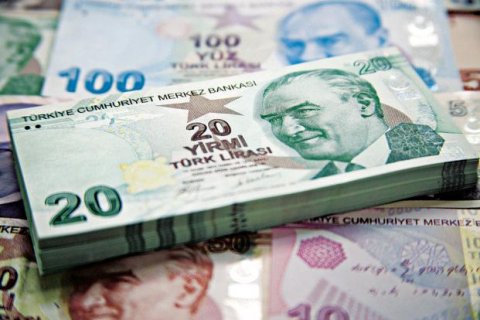
The Turkish lira is the official currency in Turkey. Turkish banknotes are in 5, 10, 20, 50, 100 and 200-lira denominations. The portrait of the first Turkish president is displayed on every banknote. One lira is divided into 100 kurus which come in 1, 5, 10, 25 and 50-kurus coins denomination. And there is also a one-lira coin which is used very often. The international currency code is TRY, and the ₺ symbol came into use in 2012. As of September 2026 the dollar is worth 48.33 TL.
Content:
- What Turkish money looks like
- Where to obtain liras?
- How to pay: cards, cash and what works
- Turkish currency tips
- How much cash you may bring in and take out
- Popular questions
What Turkish money looks like
Ataturk occupies the front of every banknote, while the back carries a different figure on each one — a handy way to tell the notes apart along with their colors.
| Denomination | Figure on the back | Roughly in dollars |
|---|---|---|
| 5 ₺ | Aydin Sayili, historian of science | 0.1 $ |
| 10 ₺ | Cahit Arf, mathematician | 0.2 $ |
| 20 ₺ | Mimar Kemaleddin, architect | 0.4 $ |
| 50 ₺ | Fatma Aliye, the first Turkish woman novelist | 1 $ |
| 100 ₺ | Buhurizade Itri, composer | 2.1 $ |
| 200 ₺ | Yunus Emre, poet | 4.1 $ |
The largest note in the country is 200 liras, which in 2026 comes to about four dollars. Talk of issuing 500 and 1,000-lira notes has been going on for years, but the Central Bank says the current set of denominations is enough for now.
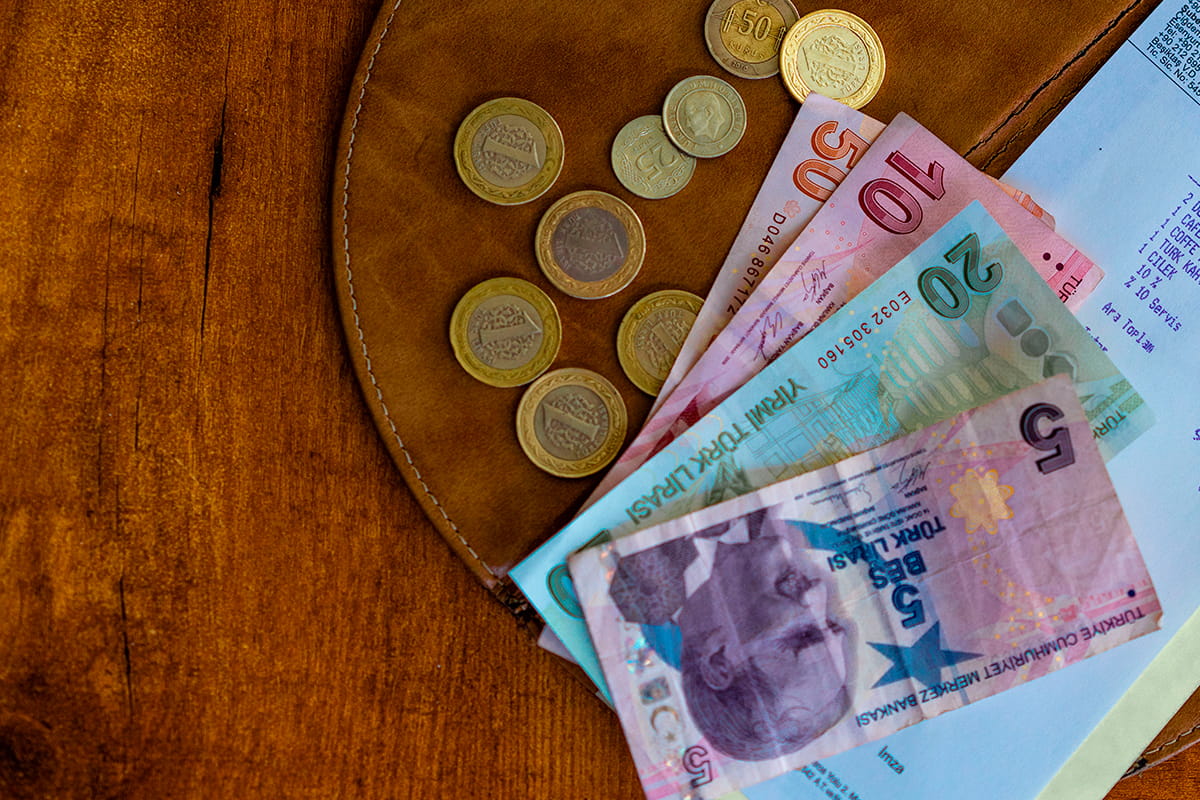
With coins it is the other way round. All kurus denominations formally remain legal tender, but 1 and 5 kurus are no longer minted and never turn up at a till: the total is simply rounded. What circulates is 25 and 50 kurus, 1 lira and 5 liras.
The present lira dates from 1 January 2005, when six zeros were removed and a million old liras became one new one. Until 2009 the currency was officially called the new Turkish lira, and then the word “new” was dropped.
Where to obtain liras?
There are several ways to get cash liras. You can exchange foreign currency at any currency exchange office or in a bank. Exchange your currency only in the official offices to avoid fraud. The banks in Turkey are open from 8.30 to 17.30 and they are closed at the weekends. But in popular resorts exchange offices usually work seven days a week.
You can also exchange currency in the post offices. The exchange rate can be even better there than in the banks. And try not to exchange big sums of money at the airports and popular tourist places as the exchange rates in such places can be not as friendly as in other places.
You can also get some cash using your card in any Turkish ATM. You can find them almost everywhere.
Exchange offices in Turkey are called doviz burosu. They post the rate in two columns: alis is the rate at which they buy your currency, satis the rate at which they sell. Official offices normally charge no commission and earn on the spread between the two columns, so the spread is what to compare.
How to pay: cards, cash and what works
Card payment is accepted almost everywhere in Turkey, but a few points are worth knowing before the trip.
- Cards issued by Russian banks do not work abroad, and the Mir system is not accepted in Turkey at all: Turkish banks left it during the autumn of 2022, and by 2026 it works neither in terminals nor in ATMs;
- cards issued by banks in other countries work as usual, as does UnionPay for cash withdrawals;
- cash in dollars or euros remains the most reliable fallback: it is changed at any exchange office and comes in useful at markets and in taxis;
- those living in the country can open an account with a Turkish bank on the strength of a residence permit card and a tax number.
One more detail that costs people money. When a terminal offers to charge the amount in your card’s currency rather than in liras, that is dynamic currency conversion, and its rate is always worse than the bank’s. The right answer to that question is to pay in liras.
What these costs look like over a month is set out in our article on the cost of living in Turkey, and the regular payments of a property owner are covered in the piece on the cost of maintaining property.
Turkish currency tips
The old guidebook advice that 100 and 200-lira notes are “rarely used and may not be accepted” is long out of date: after years of the lira losing value these are perfectly ordinary money, and 200 liras is about four dollars. The problem is the opposite one — small notes are in short supply, and a little shop may genuinely be unable to give change for a large one.
There can be some discounts if you pay with cash because the establishments do not need to pay charges to the credit card company.
In big resorts you can pay with foreign currencies: euros (accepted almost everywhere), US dollars, UK pounds sterling are accepted in some places. But the seller sets the rate, it is almost always worse than the exchange rate, and the change comes in liras. So paying in foreign currency makes sense as an exception rather than as a habit.
“A tourist loses money three times over: changing it at the airport, agreeing to be charged in their home currency, and paying in euros at a shop. Each of those is a few percent, and over a trip it adds up,” a specialist in transaction support in Turkey says.
How much cash you may bring in and take out
There is no cap on the amount you may bring with you, but there is a declaration threshold.
- Cash above 10,000 euros or the equivalent in another currency is declared both on entry and on exit;
- a separate limit applies to taking Turkish liras out of the country, and it is revised from time to time — at present it is 185,000 liras;
- an undeclared amount above the limit is seized, and the case may become a criminal one;
- property purchases and other large settlements go through a bank, not in cash.
Popular questions
What is the currency of Turkey?
The Turkish lira, international code TRY, symbol ₺. Banknotes run from 5 to 200 liras, coins from 1 kurus to 5 liras.
Does the Mir card work in Turkey?
No. Turkish banks left the system, and by 2026 it is accepted neither in shops nor in ATMs.
Where is it best to change money?
At exchange offices in town and at post offices. At airports and along the main tourist streets the rate is noticeably worse.
Can you pay in dollars and euros in Turkey?
At the resorts yes, but at the seller’s rate and with change given in liras. Changing the money first works out better.
How much cash can you carry?
The amount is not limited, but anything above 10,000 euros or the equivalent has to be declared at the border.