




New Year’s Day in Turkey is one of the most popular and important holidays. People of all ages wait for this night throughout the year. The holiday is celebrated in every country but with differences that characterize each one. Let’s see how the Turks celebrate it.
Content:
- History of the holiday
- New Year’s Eve in Turkey
- What is open and closed on 1 January
- New Year in Istanbul
- New Year in Alanya
- The New Year lottery and other traditions
- Noel Baba: the Turkish origin of Santa Claus
- Weather and what to do in winter
- What goes on the table
- Popular questions
History of the holiday
The country started marking the new year on 31 December in 1935, when 1 January became a public holiday. The Gregorian calendar itself had been adopted earlier, in 1926. The Turkish name for the celebration is yılbaşı, literally “the head of the year”, and the tree put up for it is the yılbaşı ağacı — set up for 1 January rather than for Christmas.
Attitudes still differ across the country. In more conservative households it is another evening in front of the television with nuts and seeds; in others the tree goes up, presents are exchanged and a full table is laid.
New Year’s Eve in Turkey
Globalisation has influenced not only the economy of the country but also its culture, and over the last decade or so it has become more obvious. The atmosphere of the holiday is easy to feel in the streets, brightly decorated with pine and with images of Noel Baba, the Turkish Santa Claus, especially in the big cities and the resorts of the Turkish Riviera. 31 December is a working day, but people usually finish in the afternoon and start preparing for the night ahead.
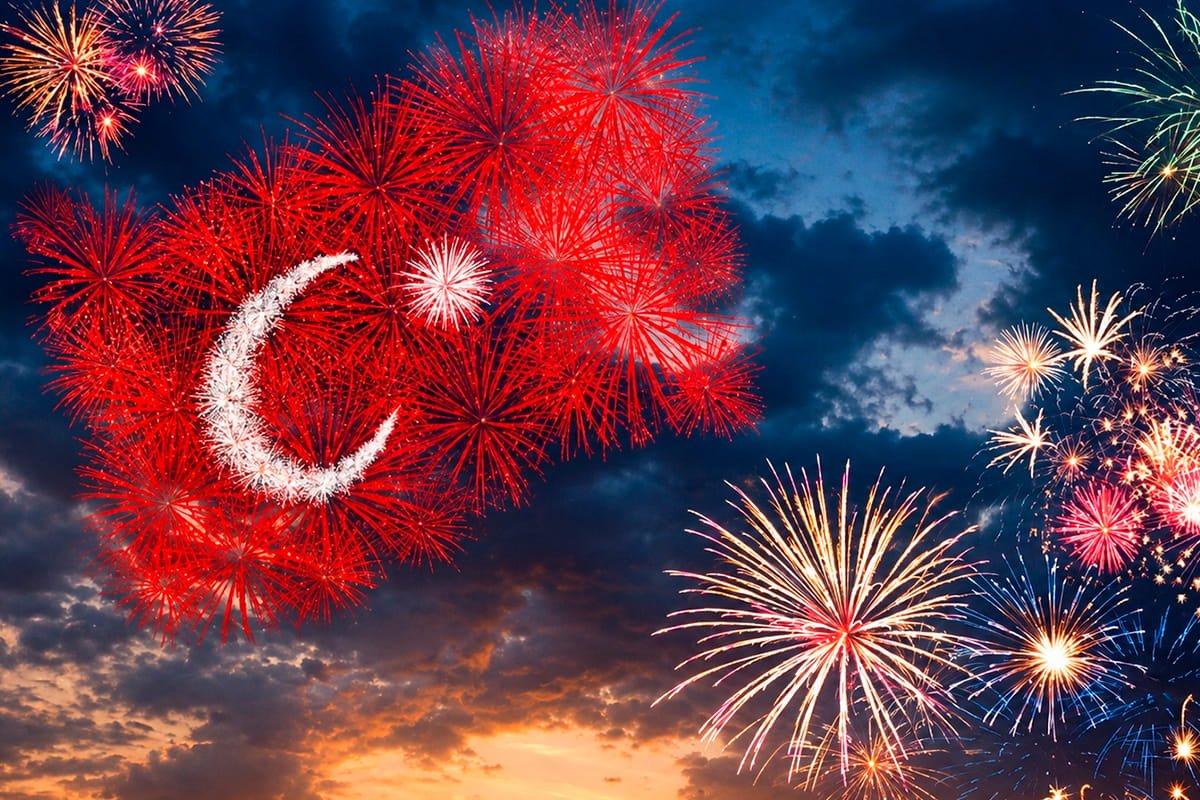
In the big cities people gather in the centre, on the main streets and squares, to watch the midnight fireworks and the street performances that follow the countdown. After that they head to restaurants and night clubs or to friends, where the parties last until dawn. Hotels hold their own celebrations.
What is open and closed on 1 January
- There is exactly one day off, 1 January. 31 December is an ordinary working day and banks and offices are open until the evening;
- on 1 January government offices, the land registry, the migration authority and most banks are closed;
- shopping centres, supermarkets, cafes and restaurants stay open, often on shorter hours;
- public transport in the big cities usually runs later than usual on New Year’s Eve;
- 25 December is a working day in Turkey and is not a public holiday.
The full calendar of public and religious holidays with exact dates is in our article on holidays in Turkey.
New Year in Istanbul
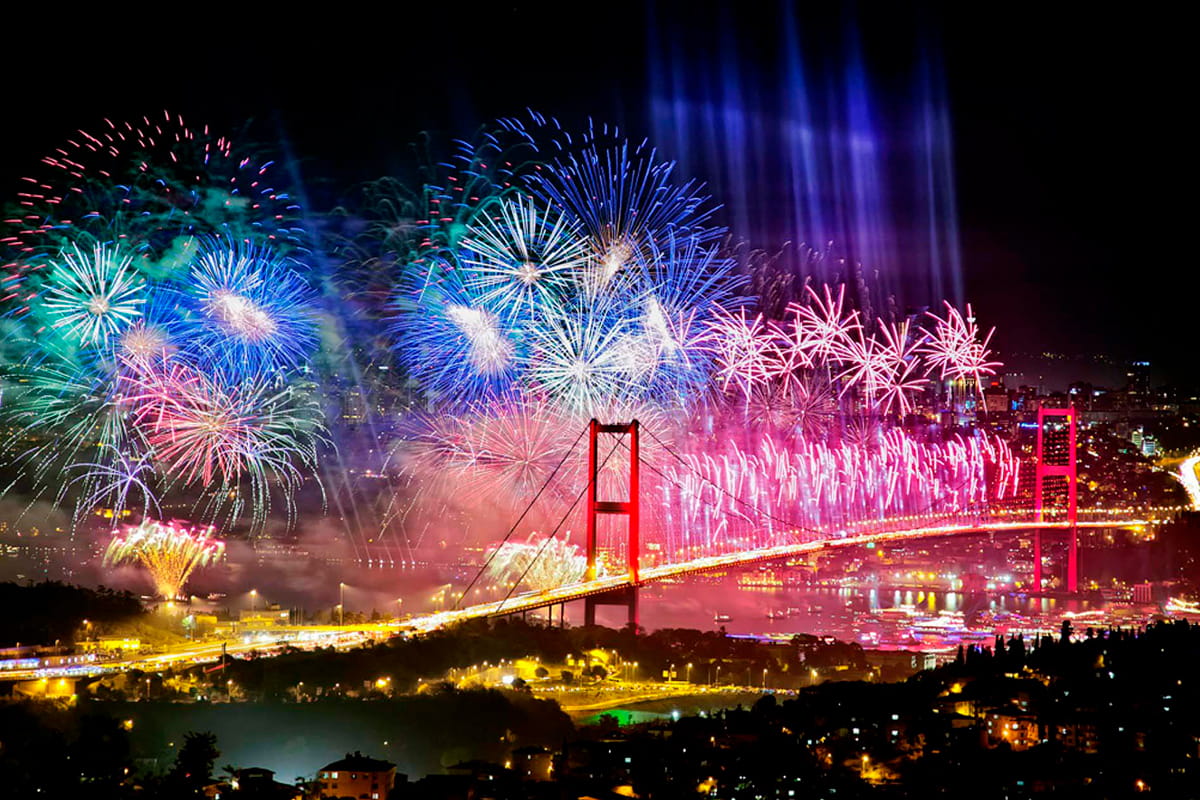
Istanbul is probably the most beautiful and the biggest city in Turkey. People from all over the country and plenty of tourists come to Istanbul to celebrate New Year. They usually gather in Taksim square and the central streets of the city, where they watch concerts, dance and join the festivities. Many visitors prefer to have their holiday dinner on a Bosphorus cruise. The final countdown and the fireworks are the main points of the night, after which people go on to parties until morning.
The other focal points are the Ortaköy waterfront with its view of the bridge and Kadıköy on the Asian side. Streets in the centre are closed to traffic, and the metro and the Marmaray run later than usual that night. Istanbul is not the capital, incidentally — that is Ankara, where the official ceremonies take place, while the street celebrations belong to Istanbul.
The next day, 1 January, people visit relatives and friends and exchange small gifts. It is a public holiday, so business offices, post offices and administrative buildings are closed.
New Year in Alanya
On the coast the holiday is quieter but by no means empty. A large decorated tree goes up on the main square in Alanya, with charity fairs around it in the weeks before, and children’s events with performances and presents from Noel Baba.
Winter Alanya is noticeably calmer than the summer version: some hotels and beach venues are shut, but rents are far lower and the town keeps a large Russian-speaking community, so there are more New Year programmes in Russian here than at other resorts.
The New Year lottery and other traditions
Alongside the table, the fireworks and the presents, families take part in the New Year lottery. The draw of the state lottery, Milli Piyango, is held on the night of 1 January and is a tradition in itself. In the draw for 2026 the top prize was 800 million lira, about 16.6 million $, and the total prize fund exceeded 4.6 billion lira. Tickets are sold whole and in fractions, quarters and halves, so large prizes are often split between several people.
There are local superstitions too. A pomegranate is smashed on the threshold at midnight — the more seeds scatter, the better the year is supposed to be. Red underwear is given and worn for luck, which is why shop windows are full of it in late December.
Noel Baba: the Turkish origin of Santa Claus
Presents in Turkey are brought by Noel Baba, and that is not a borrowing but a direct reference to local history.
Saint Nicholas, from whom both Santa Claus and Noel Baba descend, was the bishop of Myra — today Demre in Antalya province. The Church of Saint Nicholas there survives and operates as a museum, with a statue beside it. Demre is about three hours by car from Alanya, which makes it one of the more logical day trips in winter.
Weather and what to do in winter
The Mediterranean coast is mild in winter: sub-zero temperatures are rare, and the sea in the Gulf of Antalya stays around 19 to 20 degrees in January. That is not a swimming season, though, and the beach infrastructure is closed.
Istanbul and inland Anatolia are noticeably colder and snow is possible. In Cappadocia it falls regularly, which makes the balloon landscape particularly striking.
Skiing is the other winter option. The season at Uludağ near Bursa opens in December, with January and February considered the best months. At Palandöken near Erzurum the altitude opens the season earlier, at the end of November, and it runs into early April. There is also skiing at Erciyes near Kayseri, Kartalkaya in Bolu and Sarıkamış near Kars.
| Destination | What it offers in winter |
|---|---|
| Antalya and Alanya | Mild weather, quiet resorts, low rents |
| Istanbul | The main street celebrations, illuminations, possible snow |
| Cappadocia | Snowy landscapes and balloon flights |
| Uludağ, Palandöken, Erciyes | Ski season at its height |
| Demre | The Church of Saint Nicholas, a day trip from the coast |
What goes on the table
The centrepiece is roast turkey, hindi. New Year is when it is eaten most in Turkey, and supermarkets sell whole birds on promotion through December.
Around it go meze, dolma and sarma, spiced rice, salads, cheeses and the obligatory nuts and dried fruit. Dessert is baklava and tangerines, which are in season. What all these dishes are is covered in our article on traditional Turkish food, and what is served to drink alongside them in the piece on Turkish drinks.
“Visitors expect Turkish New Year to have the scale of Christmas in Europe. Here it is a family evening, a lottery ticket and a turkey, and street celebrations really only happen in Istanbul and at the resorts,” says a guide who runs winter tours.
Popular questions
Do they celebrate New Year in Turkey?
Yes. 1 January has been a public holiday since 1935. Attitudes vary: for some it is an evening at home, for others a tree, presents and a full table.
Which day is the day off?
Only 1 January. 31 December is an ordinary working day, and 25 December is not marked at all.
What is the New Year lottery?
The draw of the state Milli Piyango on the night of 1 January. In the 2026 draw the top prize was 800 million lira, about 16.6 million $.
Can you swim in winter?
The sea in the Gulf of Antalya is around 19 to 20 degrees in January, but the swimming season is over and the beach facilities are closed.
Where can you ski in Turkey?
Uludağ near Bursa, Palandöken near Erzurum, Erciyes near Kayseri, Kartalkaya in Bolu and Sarıkamış near Kars. The season runs from late November to April depending on altitude.