




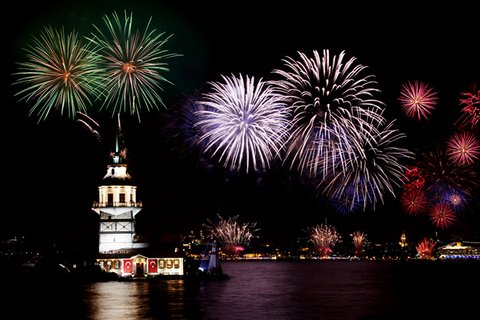
The Turkish are cheerful and welcoming people who celebrate their holidays generously. Those who bought property in Turkey and have lived there for a long time may have noticed that sometimes the streets get empty and it seems like the time has stopped, or on the contrary, suddenly crowds of people fill up the streets and they walk for days on end. And tourists who come to Turkey only for two weeks in June can also see how the Turkish celebrate their holidays.
There are nine public holidays in Turkey: seven secular ones and two religious. But there are also religious holidays which are even more important and popular than the state ones. So let’s see what holidays are celebrated in Turkey.
Content:
- Turkish public holidays
- The holiday calendar: exact dates
- Religious holidays in Turkey
- Folk festivals
- How holidays affect daily life and travel
- Popular questions
TURKISH PUBLIC HOLIDAYS
Most public holidays in Turkey were established in the twentieth century. Some of them are common holidays, like New Year, and some of them are memorable dates of the Kemalist Revolution. One of the most important days is May 19, which is the Commemoration of Atatürk, Youth and Sports Day. That day in 1919, Mustafa Kemal Ataturk landed in Samsun and started the Turkish National Movement encouraging young people to start a struggle for Turkey’s independence. That is why this day is considered one of the main holidays in the country.
Before May and Youth and Sports Day, the Children’s Day is celebrated. It is held on April 23 and was established by Mustafa Kemal Ataturk who thought that the nation’s future starts in the childhood. The streets and schools of the cities are usually decorated with flowers and balloons. Children choose their mayors and deputies. There are different competitions and concerts. Parents give presents to their children.
One more important public holiday is the Republic Day, which is celebrated on October 29. The Turkish Republic was proclaimed in 1923. In dedication to this date numerous concerts, demonstrations and parades are held. The afternoon of October 28 is a public holiday as well.
It is also worth mentioning Labor and Solidarity Day which takes place on May 1 every year. Two more non-working dates are rarely mentioned in guides: July 15, Democracy and National Unity Day, established in memory of the events of 2016, and August 30, Victory Day, marking the battle of Dumlupinar in 1922. May 29 is Istanbul Conquest Day, the conquest of the city by the Ottomans from the Byzantines in 1453, though it is not a day off. Another notable date is November 10, the day of Commemoration of Atatürk. This day most entertainment venues are closed and you can see TV shows dedicated to the first Turkey’s president. At exactly 09:05, the minute of his death, sirens sound across the country, traffic stops and people stand still. Formally it is a working day.
The holiday calendar: exact dates
Secular holidays are fixed to calendar dates and do not move. Religious ones follow the lunar calendar and shift roughly 10 to 11 days earlier each year.
| Holiday | Date | Day off |
|---|---|---|
| New Year | January 1 | Yes |
| National Sovereignty and Children’s Day | April 23 | Yes |
| Labor and Solidarity Day | May 1 | Yes |
| Commemoration of Atatürk, Youth and Sports Day | May 19 | Yes |
| Democracy and National Unity Day | July 15 | Yes |
| Victory Day | August 30 | Yes |
| Republic Day | October 29 and the afternoon of October 28 | Yes |
| Commemoration of Atatürk | November 10 | No, but the country stops at 09:05 |
| Istanbul Conquest Day | May 29 | No |
The nearest religious holidays fall on these dates:
- Ramazan Bayramı 2027 — March 9, 10 and 11, with the afternoon of March 8, the eve, also non-working;
- Kurban Bayramı 2027 — May 16 to 19, with the eve on May 15. This time the last day of the holiday coincides with May 19, itself a public holiday.
Because of the lunar shift, religious holidays will fall in spring over the next few years and later move into the winter months. The exact dates are announced in advance by the Directorate of Religious Affairs, and schools, banks and government offices plan around them.
RELIGIOUS HOLIDAYS IN TURKEY
Turkey is a Muslim country. That is why many religious holidays are more important than the state ones. The Muslim holidays are determined by the lunar calendar, so their dates can vary.
Ramadan is the holy month during which all Muslims begin to fast and don’t eat from dawn till the evening prayers. The end of Ramadan is devoted to general cleaning and preparations for Ramazan Bairam, the day when people eat sweets and give each other presents, buy new clothes, go to the cemetery and give alms to the poor. The holiday lasts three days, plus the half-day before it.
Kurban Bayrami is the holiday of Sacrifice which is celebrated 70 days after Uraza Bayrami and lasts for 4 days. According to the legend, prophet Ibrahim got God’s command to sacrifice his son. It was a kind of a test of his faith. When Ibrahim was ready to sacrifice his son for God’s sake, he was astonished to see that his son was unharmed and instead of him there was a ram slaughtered. Nowadays this day people cook meat, eat it with their family, and give food to the poor. These are the longest holidays of the year: with the eve included it comes to four and a half non-working days, and when the dates adjoin a weekend the country rests for nine days in a row.
One more important holiday is the Prophet Muhammad’s birth, which is widely celebrated and is well known all over the world. The birth and ascension of Muhammad, the Hijri New Year (the Hijra year was the first year of Muslim lunar calendar), Night of Decree (the night when the first suras of the Quran were revealed to Muhammad from Allah), Bara’at Night (the night when Allah may forgive sinners) are other religious holidays. These are known as kandil nights: they are marked with evening prayers at the mosques but are not days off.
FOLK FESTIVALS
There are a lot of different folk festivals in Turkey and they may differ from region to region. The traditional celebration of these holidays is very strong in province and some of them are also popular in big cities.
One of the most popular festivals is Hidrellez or the first day of the “early summer” which falls on May 5-6. It is believed that every year this day the prophet Hizir, the symbol of spring and good omens, wanders and helps people. This day people serve dinner, buy new clothes and give alms.
The next well-known festival is Nowruz which occurs on March 21, the day of astronomical Northward equinox. People usually visit their friends and relatives, eat pita bread, set off fireworks and organize concerts of folk groups.
One more widespread festival is the so-called Mevlana festival which takes place in Konya between December 10 and 17 in commemoration of a famous philosopher, poet and the founder of non-orthodox Islam and the brotherhood of whirling dervishes Jalaluddin Rumi, known as Mevlana. Dervishes believe that union with God is possible through the dance (sema). This dance lasts for three hours and is really spectacular and fascinating performance!
How holidays affect daily life and travel
For a tourist the holidays mean concerts and fireworks; for anyone living in the country or doing business here they also mean several days when nothing moves.
Government offices. The land registry, the migration authority, the tax office and municipalities are closed on every non-working day. A property deal cannot be registered during a bayram, documents cannot be filed and a residence permit card cannot be collected — everything shifts to the days after, and the queues that follow long holidays are noticeably longer.
Banks. Branches are shut and transfers are delayed. That matters when a payment is tied to a date: settlements are planned with a margin.
Transport and prices. During a bayram the whole country travels to see relatives: bus and domestic flight tickets sell out weeks ahead, roads are jammed and coastal hotels raise their rates. Kurban Bayramı is the most visible case, as the break is the longest.
Shops and restaurants. Supermarket chains in resort towns stay open almost always, while small family places close for a few days. During Ramadan many cafes away from the tourist areas do not serve food in daylight hours, though on the coast this is barely noticeable.
"Clients often schedule a deal for late May or early March without checking the bayram calendar. The land registry turns out to be closed, the bank does not process the payment, and the signing moves by a week. Check the holiday dates before booking flights," says the head of a transaction support department.
How the ownership procedure itself works and which documents are checked before a deal is covered in our article on the TAPU, while everyday costs and the realities of living in the country are set out in the piece on the pros and cons of living in Turkey.
Popular questions
How many public holidays are there in Turkey?
Nine non-working days: seven secular ones with fixed dates and two religious holidays, Ramazan Bayramı and Kurban Bayramı, which move every year.
When are Ramazan Bayramı and Kurban Bayramı in 2027?
Ramazan Bayramı falls on March 9, 10 and 11, with the afternoon of March 8 also non-working. Kurban Bayramı runs from May 16 to 19, with the eve on May 15.
What is celebrated on October 29?
Republic Day: the Turkish Republic was proclaimed on that date in 1923. The break begins already on the afternoon of October 28.
Do banks and government offices work during the holidays?
No. The land registry, the migration authority, the tax office and the banks are closed on every non-working day, so deals and filings are planned outside holiday weeks.
What happens on November 10?
It is the day of Commemoration of Atatürk. Formally a working day, but at 09:05 sirens sound across the country, traffic halts and a minute of silence is observed.