





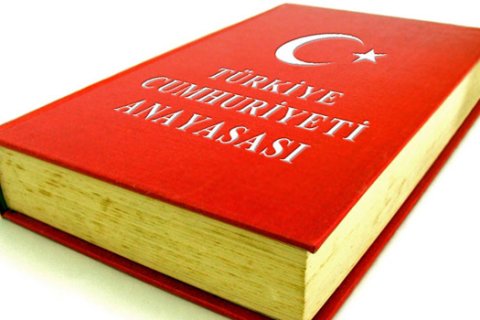
The Constitution of the Republic of Turkey is the country’s supreme legal act. The current Constitution is already the fourth in Turkish history: it was adopted on 7 November 1982 in a national referendum. It was drawn up after the military coup of 1980, and the text has since been amended more than fifteen times. The largest changes were approved in the referendums of 2010 and 2017.
Content:
- What the Constitution consists of
- What changed in 2017: a presidential republic
- The articles that cannot be amended
- How amendments are made
- The Constitutional Court and individual application
- What the Constitution guarantees an owner
- Will there be a new Constitution
- Popular questions
What the Constitution consists of
The first part sets out the fundamentals: the structure of the state, the form of government, its social and legal character, the sovereignty of the nation, the official language, the national anthem, the capital and equality before the law.
The second part describes the basic rights of citizens. It covers the inviolability of the person, personal liberty, privacy, freedom of thought and belief, of religion and conscience, and of expression and its dissemination. The economic and political rights and duties of the population are set out separately.
The third part deals in detail with the three branches of power — legislative, executive and judicial. It also contains the provisions on how the authorities and local government bodies are elected and on the declaration of a state of emergency. Later sections cover financial and economic matters, the protection of reform laws, the transitional provisions and the rules for amending the Constitution itself.
The text runs to 177 main articles plus transitional provisions. Amendments have touched some eighty of them over the years, so the version in force differs noticeably from the one voted on in 1982.
Article 1 defines the form of government: Turkey is a republic. Article 2 describes the character of the state as democratic, secular, social and governed by the rule of law. Secularism, laiklik, is enshrined here and remains one of the country’s core constitutional principles.
What changed in 2017: a presidential republic
This is the single largest change in the history of the current Constitution, and any description of Turkish government that leaves it out will be wrong.
On 16 April 2017 a referendum approved a package of amendments moving the country from a parliamentary to a presidential republic. The new system took effect after the 2018 elections.
| Item | Before 2018 | After |
|---|---|---|
| Head of government | Prime minister | The post was abolished; the president heads the executive |
| Forming the cabinet | Approved by parliament | Ministers are appointed and dismissed by the president |
| Party membership of the president | Had to leave the party | May remain a member and a party leader |
| Members of parliament | 550 | 600 |
| Term of office | 4 years | 5 years, with presidential and parliamentary elections on the same day |
| Acts of the head of state | Limited | Power to issue decrees with force of law on executive matters |
The practical consequence for a reader: the phrase “prime minister of Turkey” has been incorrect since 2018, as no such post exists.
The articles that cannot be amended
An unusual construction for a constitution: the first three articles are protected from any amendment, and Article 4 prohibits not only changing them but even proposing a change.
- Article 1 — the form of government: Turkey is a republic;
- Article 2 — the character of the state: democratic, secular, social and governed by the rule of law;
- Article 3 — the indivisibility of the country and the nation, Turkish as the state language, the flag, the anthem and Ankara as the capital.
This is why any discussion of changing the form of government or the state language in Turkey runs not into politics but into a prohibition written into the text itself.

How amendments are made
The procedure is set out in Article 175 and works through two thresholds.
- A proposal is introduced by at least a third of deputies, that is 200 out of 600;
- if an amendment is supported by three fifths of the votes, 360 deputies, the president may put it to a referendum;
- if it is supported by two thirds, 400 deputies, the president may sign it directly or still send it to a national vote;
- below 360 votes an amendment does not pass at all.
Voting on amendments in parliament is by secret ballot and takes place in two readings. Both the package of 26 amendments in 2010 and the move to a presidential republic in 2017 went through this route.
The Constitutional Court and individual application
The Constitutional Court, Anayasa Mahkemesi, reviews laws for conformity with the Constitution and hears cases against senior officials.
Since September 2012 it has had another function that matters to ordinary people: the individual application. Anyone, foreigners included, may apply to the court claiming that the state has violated their fundamental rights, but only once the ordinary judicial remedies have been exhausted. The deadline for filing is thirty days from the date the final decision takes effect.
What the Constitution guarantees an owner
For a property buyer several articles are worth knowing.
Article 35 enshrines the right to property and the right of inheritance. They may be limited only by law and only in the public interest, and property cannot be taken without compensation: expropriation for public needs is possible only against payment of the real value.
Article 41 declares the family to be the foundation of society and based on equality between spouses. The matrimonial property regime applied on divorce rests on that principle — how it works in practice is set out in our article on the divorce procedure in Turkey.
One qualification: the Constitution itself does not regulate property purchases by foreigners. That is done by the land registry law, which introduces the principle of reciprocity, limits on area and a ban on acquisitions in military zones. What is checked in the title deed is set out in our article on the TAPU.
Will there be a new Constitution
Talk of an entirely new text has gone on in Turkey for years: the current Constitution is criticized for its origins, having been prepared after a coup, and for how much of that original material remains.
As of 2026 work on a draft continues and the authorities state their intention to put a new text to a referendum. No such document has been adopted, and the Constitution of 1982 as amended in 2017 remains in force.
“The commonest error in writing about Turkish government is a reference to the prime minister. There has been no such post since 2018, and that detail alone dates the material,” a lawyer specializing in Turkish law says.
Popular questions
When was the current Constitution of Turkey adopted?
On 7 November 1982 by national referendum. It is the fourth constitution in the country’s history.
What is the form of government in Turkey?
A presidential republic since 2018. The office of prime minister has been abolished and the president heads the executive.
Which articles cannot be changed?
The first three: the form of government, the character of the state, and the provisions on the language, flag, anthem and capital. Article 4 forbids even proposing a change to them.
Is Turkey a secular state?
Yes. Secularism is enshrined in Article 2 and belongs to the unamendable provisions.
Can a foreigner apply to the Constitutional Court?
Yes. The individual application is open to anyone whose fundamental rights have been violated, but only after the ordinary courts have been exhausted.