





_480x320.jpg)
A Tapu is an official title deed verifying that you a rightful property owner. This certificate gives an owner legal title to the property and this title cannot be contested in court. A Tapu is issued by the Land Registry Office.
Content:
- Types of TAPU and what the color of the document means
- What is a TAPU
- How to check a TAPU before the deal
- How much registering a TAPU costs
- What changed by 2026
- Popular questions
A Red TAPU is issued if you become an owner of a land plot with a constructed property and this certificate lists the following:
1. Province 2. Borough, district or town 3. Block, quarter 4. Settlement, town, village 5. Street, avenue 6. Location 7. Photo of the owner 8, 9, 10. Position (coordinates) of the plot 11. Features of the plot (from Cadastral Management Office) 12, 13, 14, 15. Detailed drawing of the plot, showing precisely what belongs to a new owner 16. Condition of the property belonging to a new owner (Property type) 17. Cost of the purchased property 18. Information about the previous owner (s) 19. Information about the current owner (s) 20. TAPU number of the previous registration (changes after every ownership transfer) 21. Date of purchase of the Property by the previous owner 22. Registration data of the new TAPU 23. Date of purchase of the Property by the current owner 24. Stamp and signature of the Cadastral Management Office’s Director
Ownership is registered at the land registry office covering the location of the property. In the presence of a sworn interpreter the buyer and the seller sign a statement of no mutual claims, after which the title is transferred. The new owner is entered in the land register and receives the TAPU, the title deed.
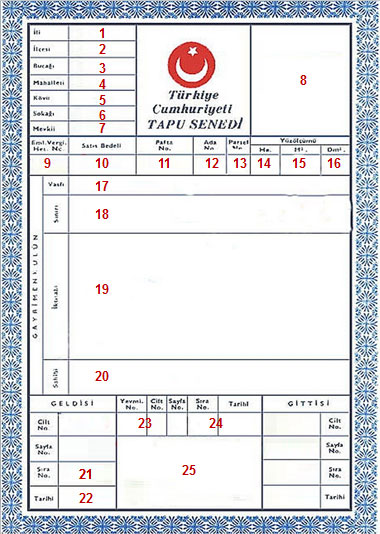
A Blue TAPU is for a plot of land without any construction permit. It contains the following:
1. Province 2. Borough, district or town 3. County 4. Block, quarter 5. Settlement, town, village 6. Street, avenue 7. Location 8. Photo of the owner 9. Tax number 10. Assessed value 11, 12, 13. Plot number 14, 15, 16. Detailed drawing of the plot 17. Type of real estate 18. Border area 19. Purchasing purpose 20. Owner 21. TAPU number of the previous registration (changes after every ownership transfer) 22. Date of purchase of the Property by the previous owner 23. Registration details of the new TAPU 24. Date of purchase of the Property by the current owner 25. Stamp and signature of the Cadastral Management Office’s Director

Types of TAPU and what the color of the document means
The color tells you the type of property, but what matters more to a buyer is the status of the right recorded in the deed. There are three situations to tell apart.
Kat mulkiyeti is full ownership of a finished apartment or villa. The building is completed, the occupancy permit (iskan) has been issued and the unit has its own entry in the land register. This is the safest option and the one banks lend against.
Kat irtifaki is the right to a future apartment in a building under construction. The building is not finished, there is no occupancy permit, and the owner’s share is still counted as a share in the land. Once the building is completed the deed is exchanged for a kat mulkiyeti.
Arsa or tarla covers land plots and farmland. Mortgages are rarely available for these, and what can be built depends on the zoning status of the particular area.
Since 2018 the land registry has issued a new generation of documents carrying a QR code, and from February 2026 the code is mandatory on every new TAPU. Scanning it confirms the authenticity of the document instantly.
What is a TAPU
When buying a property, you should consider the following:
- Property registration requires the presence of both parties or their official representatives.
- If one of the parties does not speak Turkish, a sworn interpreter is required.
- The actual address of the object of the purchase must be the same as in the Tapu.
- Legal verification of the Tapu. You need to make sure that the property you are buying is not encumbered.
- If you are buying a property under construction, you need to check if your developer has a construction plan and construction permit. If the property you are buying is already built and ready to move in, you need to ask the seller to provide a paper verifying that the property does not have any tax, water or electricity debts.
- A transaction with a foreign buyer is only registered when a market valuation report is on file. The requirement has applied since March 4, 2019, the report is produced by a licensed appraiser and it is valid for 3 months.
- Compulsory earthquake insurance, DASK, is arranged before signing — without the policy, water and electricity will not be connected.
- There are quantitative limits too: one foreigner may own no more than 30 hectares in Turkey, and the combined area owned by foreigners may not exceed 10% of the privately held land in a district. Purchases in military and strategic zones are prohibited for foreigners.
- The details of the first registration are kept in the Cadastral Archive. If the Tapu is lost, you can have it re-issued. The simplest place to start is the government portal: an extract listing the property you own is generated there free of charge, while a paper duplicate is issued by the land registry for a fee.
How to check a TAPU before the deal
The check takes a day and removes almost every risk that buyers hire lawyers for. Five steps.
Step 1. Match the property. The parcel number, district, block and area in the deed have to match what you are shown on site. A discrepancy in the address is a reason to stop.
Step 2. Request an extract on encumbrances. It reveals mortgages, seizures, court disputes, a third party’s right of residence and any note barring a sale. The owner opens such an extract in the Web Tapu system, which is entered through an account on the e-DEVLET portal.
Step 3. Confirm the status of the right. Kat mulkiyeti means the building is finished, kat irtifaki means it is still under construction. In the second case you check the building permit and the delivery dates.
Step 4. Look for debts. Property tax, utility bills and building maintenance fees pass on with the property, so clearance certificates are collected before the deal rather than after it.
Step 5. Order the valuation. The report is required to register a transaction with a foreigner and it also shows whether the seller’s price is inflated.
"What we find most often during a check is not a seizure or a mortgage but the previous owner’s unpaid building maintenance fees. The sum is rarely large, but it is the new owner who ends up paying it," says the head of a transaction support department.
How much registering a TAPU costs
Registration costs are counted separately from the price of the property.
| Expense | Amount | Comment |
|---|---|---|
| Title transfer tax (tapu harci) | 4% of the cadastral value | By law it is split between the parties, in practice the buyer usually pays it. The rate did not change in 2026 |
| Land registry fee (doner sermaye) | about 21,000 TL ($435) for a foreigner | Depends on the regional coefficient; Turkish citizens pay less |
| Valuation report | from $400 | Mandatory in a deal with a foreigner, valid for 3 months |
| Sworn interpreter | from 3,000 TL ($62) | Required if the buyer does not speak Turkish |
| DASK insurance | from 1,000 TL ($21) a year | Depends on the area, the year of construction and the region |
| Power of attorney at a notary | about 3,000 TL ($62) | If a representative handles the deal |
Figures are converted at 48.33 TL per dollar as of September 2026. The step-by-step order of the transaction with its timelines is covered in a separate article on how buying property in Turkey works.
What changed by 2026
- From February 2026 a QR code is mandatory on every new TAPU, so the document can be verified by scanning it.
- A valuation report is required for any transaction with a foreign buyer, not only for the citizenship program; it is valid for 3 months.
- Applications and approvals for the transaction are filed in the Web Tapu system, entered through a government portal account.
- An extract on the property you own can be downloaded online free of charge; the fee applies only to a paper duplicate.
- The title transfer tax rate stayed at 4% in 2026.
Popular questions
How does a red TAPU differ from a blue one?
A red one is issued for a finished property — an apartment, a villa, a shop. A blue one covers land: a plot, a field, an orchard. For a home buyer the status of the right matters more than the color: kat mulkiyeti means a completed building, kat irtifaki one still under construction.
Can a TAPU be issued without being there in person?
Yes, through a notarized power of attorney. Approvals for the transaction go through Web Tapu, but the power of attorney itself is drawn up at a Turkish notary or at a consulate.
What should you do if the TAPU is lost?
An extract on your property is generated free of charge on the government portal, and the land registry issues a paper duplicate once the fee is paid. Records of the first registration are kept in the archive, so ownership is not lost along with the document.
How much does registering a transaction cost?
The main item is 4% of the cadastral value, plus the land registry fee of about 21,000 lira for a foreigner, the valuation report, the interpreter and DASK insurance.
Are there limits for foreigners?
Yes. No more than 30 hectares per person across the country, no more than 10% of the privately held land in any one district for all foreigners combined, and a complete ban in military zones.