





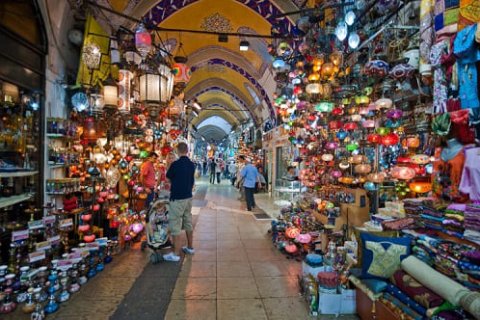
In this part of the world a bazaar is more than a place to exchange goods. It is the centre of a town’s life: conversation, gossip, news and events. In the Middle Ages you could not only shop there but play chess or backgammon, have a shave and listen to music and poetry. What is it for a visitor today?
Content:
- A whole culture in one place
- Three different things called a bazaar
- A bazaar is above all food
- The culture of trading
- How to haggle: the rules
- What to watch so as not to overpay
- Words that come in useful
- Popular questions
A whole culture in one place
A Turkish bazaar is one of the places visitors look forward to most. The atmosphere, the sellers and the trading customs give a sense of the country that a shopping centre never will. You can wander for a whole day without getting bored: spices, freshly ground coffee, roasted nuts, jewellery.
What is striking is that people come here to shop rather than to look. Turks buy food, spices and sweets, clothes and shoes, jewellery and household goods — everything there is to buy.
Three different things called a bazaar
The word covers three rather different places in Turkey, and it is worth telling them apart: the prices, the crowd and the appropriateness of haggling are not the same.
| Format | What it is | Who shops there |
|---|---|---|
| Kapalıçarşı, the covered bazaar | A historic building of shops under one roof. The Istanbul one has some 4,000 shops on 66 streets and up to 350,000 visitors a day | Mostly visitors; prices are higher |
| Mısır Çarşısı, the Spice Bazaar | A covered market of spices, dried fruit, sweets and tea | Both visitors and locals |
| Haftalık pazar, the neighbourhood market | Street stalls set up one day a week in each district | Local residents; the lowest prices |
| Balık pazarı, the fish market | Permanent rows by the water and in town centres | Locals, every day |
For anyone living in Turkey the neighbourhood market is the important one. Each district has its day of the week, the stalls go up in the morning and come down by evening, and the produce is noticeably cheaper and fresher than in a supermarket. The schedule is posted by the municipality, and asking a neighbour once is enough.
The Istanbul Grand Bazaar is open six days a week, roughly from 10:00 to 19:00, and closed on Sundays — worth remembering when planning a route.
A bazaar is above all food
Turkish markets are loud with colour, and nowhere else holds this many spices. The stalls are piled year-round with fruit, vegetables and roots, much of it unfamiliar.
Each bazaar has its own character. Nowhere else will you find the range of spices, dried fruit, olives and cheeses that the Spice Bazaar in Istanbul carries.
Fish markets exist in every coastal town, with seafood from four seas: the Aegean, the Black Sea, the Mediterranean and the Marmara. Everything arrives fresh off the boats, and the fish is cleaned and cut for you. You can then take your purchase to a nearby restaurant and have it cooked — the service is called pişirme and carries a small separate charge.
Seasonality is felt far more sharply than in a supermarket: cherries in May, figs in August and September, pomegranates and persimmons from October, citrus in winter. Whatever is in season is cheap, and the gap with out-of-season produce runs to several times the price. What all of it turns into on the table is covered in our article on traditional Turkish food.
The culture of trading
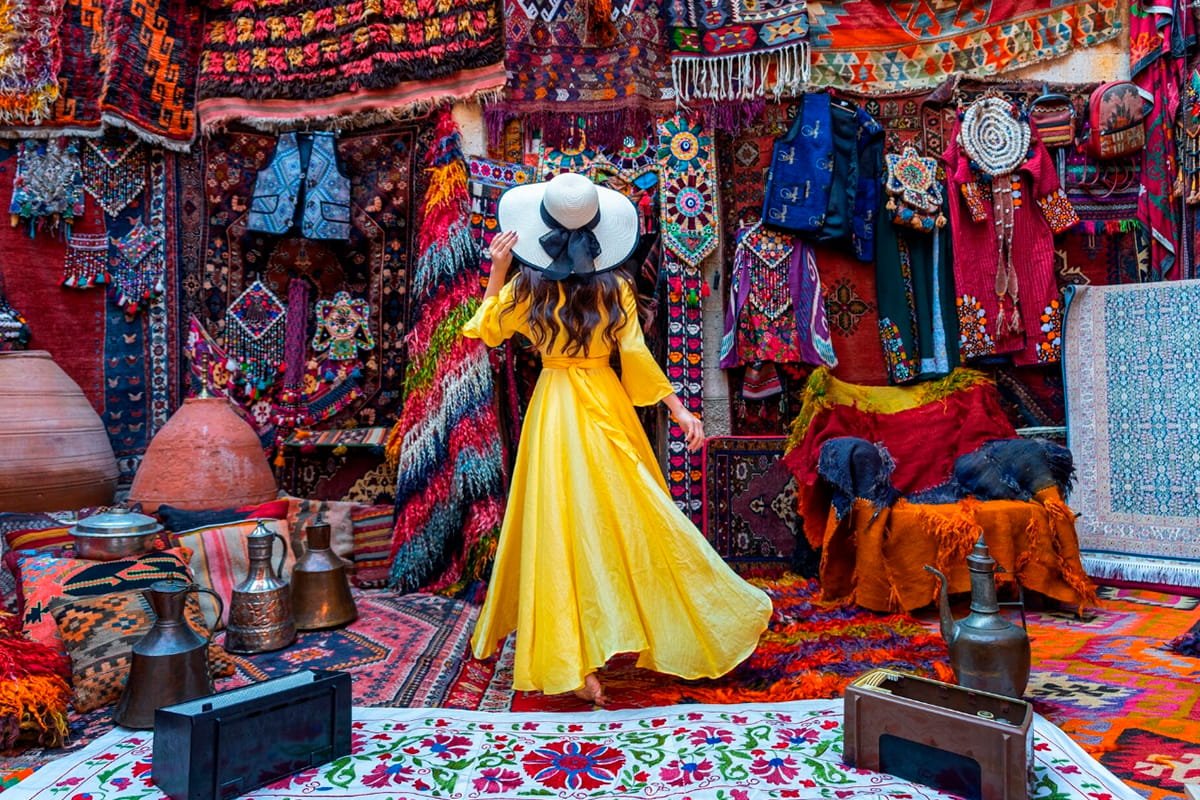
Have you ever tried haggling? A bazaar is the place, though it is less simple than it looks. At the big Istanbul bazaar you will meet high asking prices, but sellers like giving discounts. You will be greeted warmly, offered tea, asked about your holiday, and somewhere in the conversation you will arrive at a price. Another way to save is simply to come at the end of the day.
One qualification: haggling is not appropriate everywhere. At a tourist covered bazaar it is expected and built into the first price. At a neighbourhood market there is little of it — prices there are already close to the floor, though sellers will happily knock something off at closing time for what is left. In supermarkets and chain stores prices are fixed and haggling is not done.
How to haggle: the rules
- Ask the price and do not name yours first — let the seller open;
- a reasonable landmark at a tourist bazaar is half to two thirds of the first figure, and you meet in the middle;
- only haggle for something you actually intend to buy: agreeing a price and walking away puts the seller in an awkward position;
- the tea you are offered commits you to nothing — it is ordinary courtesy, not a deposit;
- the discount for several items is larger than for one, and that is the argument that works;
- cash gives you leverage; sellers concede less readily on card payments;
- a smile and a few words of Turkish bring the price down more reliably than a long argument.
What to watch so as not to overpay
- Watch the scales and what goes into the bag: the classic move is to offer a taste of the good product and pack a different one;
- “real saffron” at a small price never is: what is usually sold under the name is safflower;
- nuts and dried fruit are cheaper loose at a neighbourhood market than in pretty packaging at a tourist one;
- “100% leather” and branded goods at a bazaar are a matter of trust rather than guarantee;
- ask the price per kilo rather than per bag: tourist stalls like quoting per package;
- at sweet shops, ask to have things weighed in front of you.
And a practical note on money: markets run mostly on cash and cards are not accepted everywhere. How Turkish money works and where the exchange rate is best is set out in our article on Turkish currency.
Words that come in useful
| English | Turkish | Pronunciation |
|---|---|---|
| How much is this? | Bu ne kadar? | bu ne ka-DAR |
| That is very expensive | Çok pahalı | chok pa-ha-LUH |
| Can it be cheaper? | Daha ucuz olur mu? | da-HA u-JUZ o-LUR mu |
| Half a kilo, please | Yarım kilo lütfen | ya-RUHM ki-LO LEWT-fen |
| I am just looking | Bakıyorum | ba-KUH-yo-rum |
| Thank you, I do not want it | Teşekkürler, istemiyorum | te-shek-kewr-LER is-te-mi-YO-rum |
More phrases for markets, cafes and everyday situations are in our short Turkish phrasebook.
“Visitors go to the covered bazaar and think they have seen a Turkish market. The real one is the neighbourhood market on a Tuesday morning: no carpets, no souvenirs, tomatoes at half the price and a seller who remembers your face,” says a guide who runs food tours.
Popular questions
Do you have to haggle?
At a tourist covered bazaar it is expected and built into the first price. At a neighbourhood market there is little haggling, and in supermarkets prices are fixed.
When is the Grand Bazaar in Istanbul open?
Six days a week, roughly from 10:00 to 19:00. It is closed on Sundays.
Where is food cheapest?
At the neighbourhood market on its day of the week. Fruit and vegetables there are fresher and noticeably cheaper than in a supermarket or at a tourist bazaar.
Can you pay by card?
At the covered bazaars usually yes; at neighbourhood markets it is almost always cash only.
Is fake saffron really sold at bazaars?
Cheap “saffron” is normally safflower. The real thing is expensive and sold in tiny quantities.