






Turkey attracts millions of tourists annually. Citizens of some countries are allowed to visit Turkey for a short period without a special permit. For instance, citizens of the USA, Canada, and most EU countries do not need a visa for a short-term visit of up to 60 days. However, those who plan to relocate to Turkey permanently may require more than 60 days of stay in the country. Read our article to learn how to obtain a long-term Turkish visa.
Content:
- Foreigners in Turkey
- Visa policy between Turkey and other countries
- 60 days of staying in Turkey
- How the 90/180 limit is counted
- Extension of stay for more than 60 days
- Vacation in Turkey for over 60 days
- Turkey Visa
- Visa application procedure
- Obtaining a residence permit
- Residence permit and Turkish citizenship
- Fines for Visa violations
- Which option fits your situation
- Popular questions
- We can help you buy real estate in Turkey and get a residence permit or citizenship
Foreigners in Turkey
Turkey attracts a significant number of foreign citizens – both tourists and those who want to move to the country for a long time. As of May 2026 there were 1,237,343 valid residence permits in the country, with citizens of Turkmenistan, Azerbaijan and Syria holding the most. Russians are also among the top 10 representatives of foreign countries who have valid long-term leases or even their own house in Turkey.
According to statistical data, the number of foreigners in the Turkish Republic has been falling in recent years, and it shows in transactions: foreigners bought 5,681 properties in January to April 2026, 11.6% fewer than a year earlier. For some, real estate in Turkey is an option for a short vacation. However, many owners decide to relocate to Turkey permanently. In this case, the question of legal long-term stay in the territory of the state becomes particularly relevant.
Visa policy between Turkey and other countries
Citizens of many countries can stay in Turkey up to 60 days without a visa. Some of these countries include the United States, Canada, the United Kingdom, most European Union countries, Australia, New Zealand, Japan, South Korea, Malaysia, and Singapore. However, please note that visa policies can change from time to time, so it’s always a good idea to check with the Turkish embassy or consulate in your country before you travel.
Allowable purposes of visa-free travel are also defined, which include tourism, visiting relatives, transit, or business travel. Foreigners most often choose tourism as the purpose of their trip. To enter the country without a visa, they need to have:
- a passport with a validity period of at least 120 days from the date of entry and a blank page for a visa stamp;
- return tickets that prove that the tourist really plans to leave within the established period. A regular or electronic ticket for a plane, train, etc. will work;
- a tourist voucher or hotel reservation;
- proof of financial capability – $50 per day of stay.
In practice, when entering the country without a visa, only a passport will be required at the border crossing. Turkish border guards have the right to request all other documents, but they do this extremely rarely. However, if a check does take place, the absence of documents may become a reason for denial of entry.
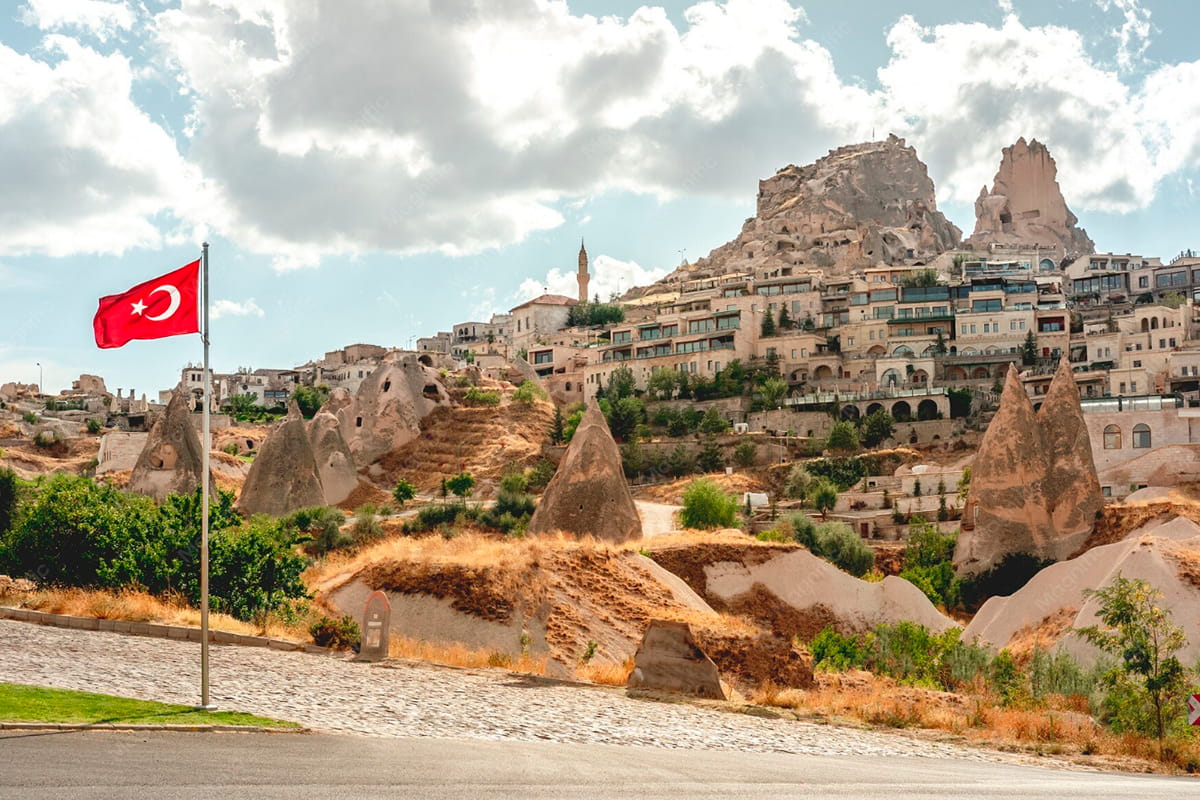
60 days of staying in Turkey
The period during which foreigners can stay in the country without a visa is 90 days within six months, but they can only stay continuously for up to 60 days. The countdown starts from the date stamped on their passport upon entry. Foreign citizens can cross the border any number of times. It is important that the total length of stay does not exceed the established limits (for citizens of most countries – 90 days within six months). There are penalties for those who violate this rule.
How the 90/180 limit is counted
This is where the costly misunderstanding usually arises. The 90/180 rule works on a rolling window: on the day of entry the border officer looks back 180 days and adds up every day spent in the country during that period.
Which leads to the main point: leaving the country does not reset the counter. Flying to Georgia for a day and coming back "for another 60 days" does not work — on your return you keep spending the same 90 days out of the half-year.
An example. Someone stays in Turkey for 60 days straight, from March 1 to April 29. Thirty days are left, and they can be used before the end of the rolling window: a three-week trip in June, say. A full-length stay becomes possible again only once the earliest of those days drop out of the 180-day window.
The easiest way to check your balance is a visa-free day calculator, or a manual list of every entry and exit over the past six months. The officer at the border counts stamps, not recollections.
"The most common mistake is believing that a visa run resets the clock. People fly out for a day, come back, and find at the border that the limit is gone. What follows is a fine and an entry ban," says a relocation expert.
Extension of stay for more than 60 days
If a foreigner needs to stay in the country for more than the 60 days allowed under visa-free travel, they have several options:
- leave and re-enter — but only within the days still left from the 90/180 allowance;
- apply for a short-term residence permit, on tourism or another ground;
- apply for a visa at a consulate, if the purpose of the trip falls outside the visa-free list;
- apply for a residence permit based on a property purchase, work, study or family.
Depending on the goals and objectives of the foreign citizen, they can use any of these methods to extend their legal stay. That’s why we suggest taking a closer look at each option.
Vacation in Turkey for over 60 days
Extensions used to be handled by the police, but since 2013 the stay of foreigners has been managed by the migration authority, Göç İdaresi, and a separate "permission for 90 days" no longer exists. Anyone who wants to stay beyond the visa-free period applies for a short-term residence permit — the tourist ikamet.
The application is filed online at e-ikamet.goc.gov.tr before the visa-free period runs out, after which the applicant attends the office with the original documents. You will need:
- a valid passport, with at least 60 days of validity beyond the requested permit;
- 4 biometric photographs;
- a notarized rental agreement or the title deed for your own property;
- proof of income — 1.5 times the minimum wage, that is 42,112.50 TL ($871) a month for the applicant;
- health insurance covering the whole validity of the permit;
- a Turkish tax number and receipts for the fees.
A decision is made within 90 days, and the applicant stays in the country legally throughout. A detailed breakdown of the procedure, timelines and costs is collected in our article on the ikamet in Turkey.
Turkey Visa
For a long trip, it is necessary to obtain a Turkey visa. To obtain it, one must apply in advance to the consulate with a prepared package of documents. The application can be submitted up to three months before the planned date of travel. Citizens of visa-free countries do not always need one: while the trip fits inside the visa-free allowance a passport is enough, and for living in the country long term a residence permit is the usual route.
Visa documents
The basic package for visa application includes:
- A completed application form in the native language (provided by the consulate);
- 2 photos sized 5x6 cm;
- A copy of the passport pages with personal information;
- Proof of financial capability – bank statement or income certificate. The calculation is $50 per day.
Other necessary documents are determined depending on the type of visa.
Long-stay tourist Visa
The required documents for a visa application include the basic package and proof of hotel reservation or other accommodation during the period of stay.
Work Visa
To apply for a work permit, a signed employment contract, a work permit for foreigners, and an invitation letter from a local employer are required. The permit is issued for a period of one year.
Real Estate Visa
Owning property is a basis for obtaining a long-term visa. For instance, an apartment owner in Turkey can apply to the consulate with the basic package of visa documents, a copy of their "tapu" (property title deed), and a utility bill under their name as proof of ownership. On this basis, they can obtain permission for a long-term stay that lasts up to 2 years.
Family Member Visa
This type of visa can be requested for a trip to visit relatives or friends. A notarized invitation from the resident in its original form will be a supplement to the main documents. In other words, the citizen or resident must write an invitation, have it notarized and send it to their relative or friend who wishes to visit them. The guest then submits the invitation along with other required documents to the consulate.
Business Visa
This is an option for business people who are traveling for resolving business issues, participating in conferences, negotiations, etc. In this case, the inviting party is not a private resident but a local company. An invitation is also drawn up for the guest, notarized, and sent in the original for submission to the consulate.
Marriage Visa
Spouses of Turkish citizens can also obtain the right to long-term entry. In addition to the standard set of documents, the following will be required:
- The original invitation from the Turkish spouse;
- A document confirming the identity of the spouse (copy);
- A marriage certificate.
Language Courses Visa
Studying the language can also be a basis for long-term stay. In addition to the general documents, the following should be provided:
- Proof of accommodation (invitation from a resident where the applicant plans to live, "tapu" or rental agreement);
- A certificate of registration in an educational institution;
- A certificate of criminal record.
Visa application procedure
Documents for a visa application can only be submitted in person. Other individuals, even with an official power of attorney, cannot do this on behalf of the applicant. The same applies to submitting an online or paper application. If visa issues need to be resolved for the whole family, it is sufficient for only one member and documents confirming the relationship to be present.
The processing time for a visa application may take up to 2 months. In some cases, it may be extended up to 3 months. Processing times also depend on the workload of the consulate, which increases during summer. This should be taken into account when submitting an application.
The status of an application is checked with the consulate where the documents were filed: there is no single online tracking service. If the decision is positive, the applicant is invited to collect the passport with the visa affixed.
Cost of Visa Processing
The visa fee depends on the type of visa and the applicant’s nationality, so the current amount is confirmed at the consulate when filing. A work visa costs more: on top of the consular fee there is the charge for the work permit, which the employer arranges through the relevant ministry.

Obtaining a residence permit
It is possible to legally move to Turkey by obtaining a residence permit (ikamet). It entitles the holder to reside in the country for an extended period.
To obtain a residence permit, one must have a valid reason:
- Family reunification;
- Business and investment in the Turkish economy;
- Property acquisition;
- Official employment;
- Studying at a local university;
- Receiving medical treatment at local healthcare institutions;
- Tourism and other long stays beyond the visa-free allowance;
- Humanitarian reasons.
With one of these reasons, foreign citizens are entitled to receive a residence permit for up to 2 years at a time, while investors are granted permits for up to 5 years. This type of permit is often chosen by persons moving to Turkey permanently. The most common grounds for obtaining a residence permit are tourism, family reunification, and education.
Purchasing property is also a basis for obtaining a residence permit. Since October 16, 2023 a monetary threshold applies: the appraised value of the property must be at least $200,000 and the property must be residential. The old rule, under which any apartment qualified regardless of price, no longer works. Only those persons listed in the title deed can obtain a residence permit on this basis. If the ownership is only registered under one family member, then only they can obtain a residence permit on this basis. Other family members can obtain a residence permit based on family reunification.
The second restriction concerns the address. Neighborhoods where the share of foreign residents exceeds 20% are closed to new registrations, and the decision is taken by specific address rather than by city. In 2026 some of those neighborhoods reopened, so the status is checked before renting or buying.
Documents for residence permit
To obtain a residence permit, the applicant must provide the following documents to the immigration office:
- Application;
- Original and copy of passport;
- 4 biometric photographs;
- Proof of income;
- Local tax identification number;
- Health insurance;
- Receipt of payment for state fees.
The list of required documents may vary depending on the grounds for obtaining the residence permit. Since 2024 only a notarized rental agreement is accepted.
Procedure for obtaining a residence permit
The applicant must submit an electronic application on the immigration office’s website, verify the accuracy of the prepared document package, clarify the address of the immigration office, and select a date for their visit. On the chosen day, the collected documents should be brought to the designated immigration office and an interview will be conducted with an officer. The documents will then be sent for review. A decision is made within 90 days at most, and once approved the card is delivered by PTT.
The cost of a residence permit
Obtaining a residence permit will require expenses such as:
- the residence permit card — 964 TL, the same amount for everyone;
- the permit fee itself — set on the principle of reciprocity, so it differs by nationality;
- health insurance — 2,700 to 7,200 TL a year depending on age and coverage;
- notarized translations and certification of the rental agreement.
Altogether it is worth budgeting around 11,000 TL ($230) per adult.
Residence permit and Turkish citizenship
The open-ended permit in Turkey is called a long-term residence permit, and it becomes available after 8 years of uninterrupted residence. If a foreigner has not left Turkey for more than 365 days in the last 5 years, or no more than 180 days per year, they have the opportunity to obtain a permanent residence permit. This practically equates the foreigner to a citizen, but some opportunities remain unavailable:
- Voting and being elected to governing bodies;
- Holding public office;
- Importing transportation;
- Serving in the armed forces.
However, permanent residency may be annulled if the resident remains outside of the country for more than 1 year, with exceptions for medical treatment, government service, and education abroad.
Obtaining citizenship is the highest degree of recognition as a foreigner in another country. In the Republic of Turkey, one can apply for citizenship after five years of residence with a valid residence permit. If married to a Turkish citizen, a spouse can apply for citizenship after three years of marriage, provided the couple lives together as a family.
Obtaining citizenship for investors
A simpler and faster way to obtain citizenship, along with all the associated privileges, is to participate in the state’s investment program. The essence of this program is that by investing funds in the local economy, the investor can become a citizen of the country under a simplified scheme.
Citizenship can be granted in the following cases:
- Purchasing real estate worth at least $400,000, with resale barred for three years;
- Investing in local production for at least $500,000;
- Depositing money in a local bank or purchasing government bonds for at least $500,000;
- Creating 50 or more jobs within the country.
Meeting one of these conditions allows a foreigner to become a Turkish citizen without years of waiting. How a residence permit differs from a passport, and which suits which goal, is covered in our article on residence or citizenship of Turkey.
Fines for Visa violations
If a foreigner violates the visa regime in terms of their stay period, they may face fines and entry restrictions. The fine is calculated from the number of days overstayed and from the person’s nationality — reciprocity means the amounts differ from country to country, so the final figure is given at the border.
Beyond the money, the consequences are:
- a restriction code is entered in the database and shows up at every subsequent attempt to enter;
- an entry ban is imposed, from a few months to five years depending on the length of the overstay;
- refusing to pay the fine at the border brings the maximum ban;
- the violation complicates later residence permit applications: the migration authority sees the history.
The fine must be paid upon crossing the border.
Which option fits your situation
| Goal | Solution | What to keep in mind |
|---|---|---|
| Holidays and short trips | Visa-free entry | 60 days in a row and 90 days within any 180; leaving does not reset the allowance |
| A season, wintering, remote work | Short-term residence permit | Income of 42,112.50 TL a month, insurance, notarized lease, an open neighborhood |
| Moving with a property purchase | Permit through real estate | Appraised value from $200,000, residential property only |
| Working under a contract | Work permit | Arranged by the employer; no separate residence permit needed |
| Studying | Student permit | Issued for the duration of the course, covers the student only |
| Living in the country long term | Long-term permit or citizenship | 8 years of uninterrupted residence for open-ended status, 5 years for citizenship |
| A passport quickly | Citizenship by investment | From $400,000 in property with resale barred for 3 years |
Popular questions
How many days can you stay in Turkey without a visa?
Up to 60 days in a row and no more than 90 days within any 180. The count runs on a rolling window: the officer looks back six months and adds up every day.
Does leaving the country reset the day count?
No. This is the most common misconception. After leaving and returning you keep spending the same 90 days from the half-year allowance.
How do you stay in Turkey beyond the visa-free period?
Apply for a short-term residence permit before the visa-free days run out. The grounds can be a rented home, a property purchase, study, work or family.
Does buying an apartment grant the right to live in Turkey?
Yes, if the appraised value of the property is at least $200,000. The permit is issued for up to 2 years and can be renewed.
What happens if you overstay?
A fine calculated from the days and your nationality, a restriction code in the database and an entry ban ranging from a few months to five years.
We can help you buy real estate in Turkey and get a residence permit or citizenship
Buying property allows you to legally stay in the Republic of Turkey for a long time. When purchasing real estate, you will have the basis for obtaining a residence permit, and if the value of your property is $400,000 or more, you will have the opportunity to immediately obtain citizenship. Many foreigners have already taken advantage of these opportunities and gained the right to legally reside in the territory of the Republic of Turkey.
You can choose quality Turkish real estate right now on our website. We have advantageous offers from developers, agencies, and private sellers in various price categories. When choosing a property it is worth asking our specialists about the status of the particular neighborhood: some areas remain closed to foreign registration. Cozy apartments in Turkey, houses and villas, apartments, and penthouses - we have properties to meet any demand. Start searching for real estate in this beautiful country right now!