





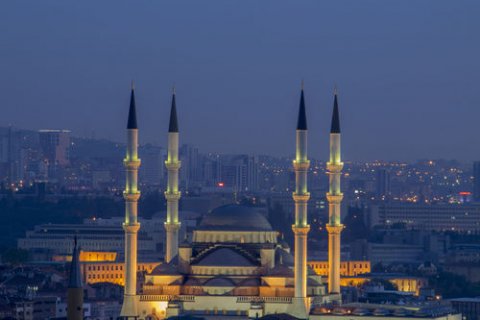
The mosques of Turkey were built to impress. Many of them went up on the proceeds of military victories, as thanks to the Almighty and as a demonstration of the empire’s standing, so nobody economised: gold, marble and hand-painted tile went in by the ton.
Most of the famous ones are working mosques rather than monuments — prayers are held in them five times a day and the faithful still gather. Istanbul alone has around three thousand of them, and a few draw long queues of visitors.
Content:
- The Blue Mosque in Istanbul
- Süleymaniye in Istanbul
- Hagia Sophia in Istanbul
- Hürrem in Istanbul
- Fatih in Istanbul
- Çamlıca: the largest mosque in the country
- Selimiye in Edirne
- How to visit a mosque: rules for visitors
- Popular questions
The Blue Mosque in Istanbul
The signature building of Istanbul and one of the largest mosques in Turkey, it holds around 10,000 people at once and has six minarets rather than the usual four, as many as the sanctuary in Mecca. The story goes that this is why a further minaret was added to the Masjid al-Haram, to restore its precedence.
It stands by the Sea of Marmara in the historic centre and was built on the orders of Sultan Ahmed I, who wanted to restore the empire’s standing after a run of military defeats. Construction began in 1609 under Sedefkâr Mehmet Ağa, the pupil and chief assistant of the great Sinan, who set out to surpass his teacher. The dome is decorated with verses from the Quran, and the prayer niche is carved from a single piece of marble with black stone brought from Mecca.
Its official name is the Sultanahmet Mosque; the “blue” comes from the İznik tiles inside. It spent several years partly closed for restoration and the interior is now fully accessible again. Entry is free, as it is at every working mosque in the country.
Süleymaniye in Istanbul
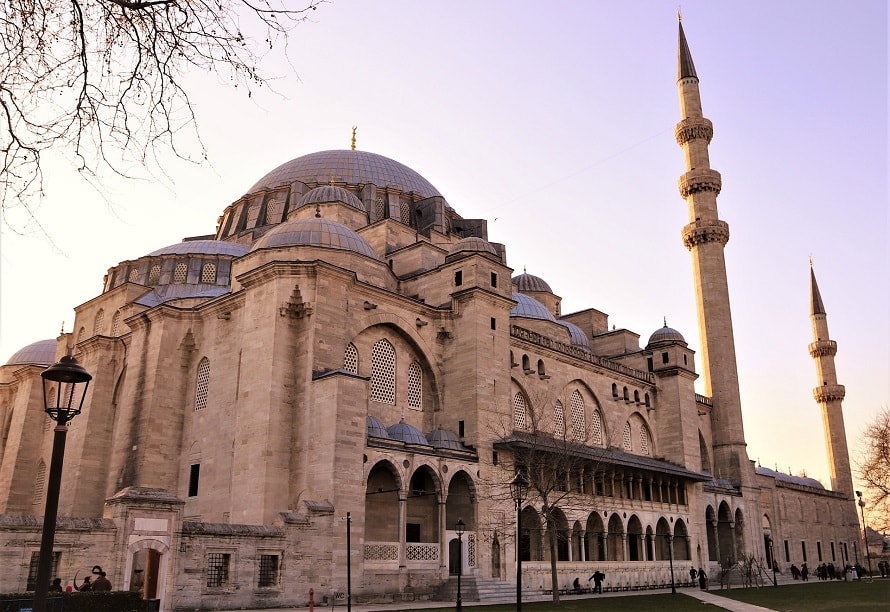
Süleymaniye is the largest mosque in Istanbul and a masterpiece by Sinan, built between about 1550 and 1557. It has come through 89 major earthquakes and a fire, and in 1766 part of the dome collapsed, yet it has kept its proportions and still draws visitors from all over the world.
The complex is a city within a city: alongside the prayer halls there were baths, schools, libraries and kitchens. Legend has it that the Persian shah once sent Sultan Süleyman a quantity of diamonds, emeralds and rubies, hinting that he lacked the funds to finish the building. The sultan was angry enough to order the stones thrown into the foundations of one of the minarets.
In the courtyard stand the türbe, the tombs of Süleyman the Magnificent and Hürrem Sultan, and Sinan himself is buried nearby. The terrace behind the mosque offers one of the best views of the Golden Horn, with far fewer visitors than at the Blue Mosque.
Hagia Sophia in Istanbul
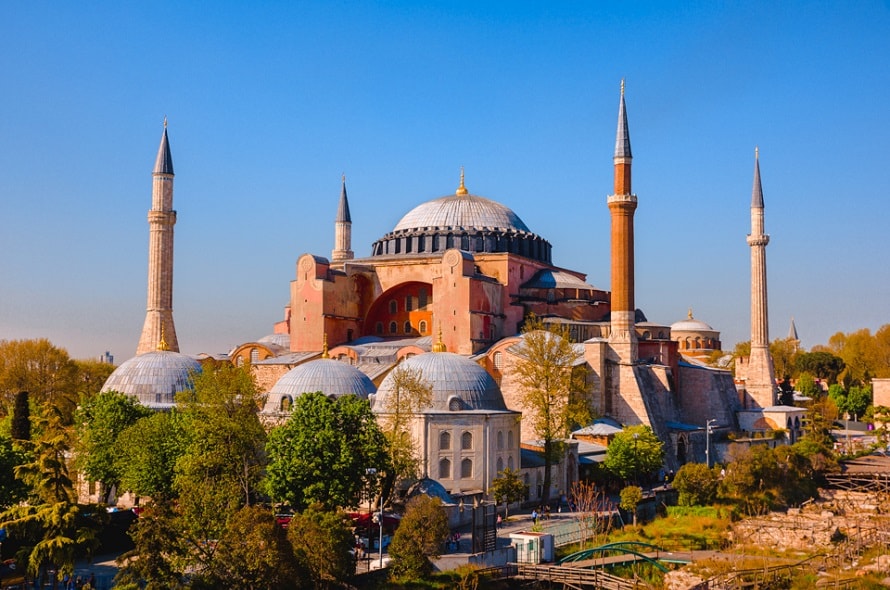
Hagia Sophia has the longest and most dramatic history of them all. The Church of the Holy Wisdom was once the largest Orthodox cathedral in the world and the symbol of Byzantine power. A church stood on the site as early as 324, but the present building was begun in 532. More than 10,000 people worked on the site each day, and the most expensive materials went into it: gold, silver, ivory, pink, red and green marble, precious stones. Justinian had planned to cover the walls in gold but was warned the building would be seized and looted, and gave up the idea.
After the Ottoman conquest of Constantinople four minarets were added and the building became Ayasofya. It served as a museum for almost ninety years — the status described in older guidebooks — and since 24 July 2020 it has been a working mosque again. It remains on the UNESCO World Heritage list, and most of the frescoes and mosaics have survived.
What that means in practice. Entry to the prayer hall is free, as at any mosque, but the usual rules apply: shoes off, heads covered for women, and no admission during prayers. The upper gallery, where the Byzantine mosaics are best seen, has been ticketed since 2024: 25 euros for foreign visitors, 800 TL for Turkish citizens and 425 TL with a museum card. The gallery is open until 19:00, and buying online avoids the queue.
Hürrem in Istanbul
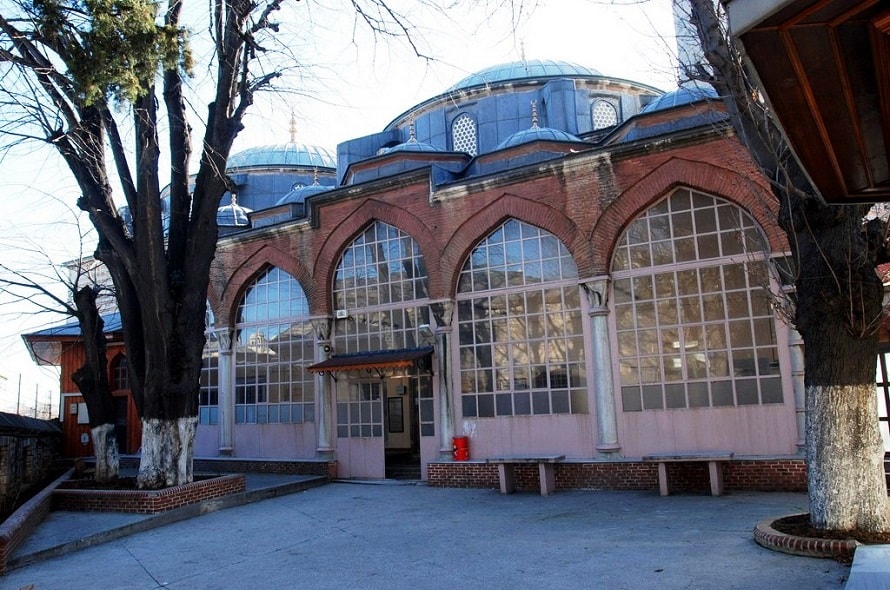
The Haseki Hürrem Sultan complex was built by Sultan Süleyman in honour of Roxelana, the concubine who rose to unprecedented power at the Ottoman court. Fittingly, it stands on the site of a former women’s slave market, where she herself had been sold into the harem.
Hürrem went on to found her own charitable endowment and built a complex around the mosque: a medrese, a hospital and a kitchen for the poor. Modest as the funds were, it became one of Sinan’s earliest works. The complex is in the Aksaray district, while the bathhouse that carries her name, also by Sinan, stands between the Blue Mosque and Hagia Sophia and still operates as a hammam.
Fatih in Istanbul
Fatih, the Conqueror’s Mosque, was among the first Ottoman buildings raised in the newly taken city, and the mausoleum of Mehmed II, the conqueror of Constantinople, stands here — one of the most important shrines in Istanbul.
It occupies the site of the Byzantine Church of the Holy Apostles on the European side. The original complex was enormous, taking in eight medreses, a library, a primary school, a hammam, a hospital, a caravanserai, a hostel and a public kitchen that fed the poor. An earthquake destroyed the building in 1766 and it was rebuilt in 1771 in the baroque style, with an interior copying Sinan’s designs.
The district around the mosque is the most conservative part of the historic centre, so dress more modestly here than on İstiklal. On Wednesdays a large street market fills the streets around the complex.
Çamlıca: the largest mosque in the country
The biggest mosque in Turkey is not Ottoman but modern: Çamlıca, on the Asian side of Istanbul, opened in 2019 and holds tens of thousands of worshippers.
It stands on Çamlıca hill, the highest point in the city, so the terrace looks out over both shores of the Bosphorus. The complex houses a museum of Islamic civilisation, a library, an art gallery and underground parking. There are far fewer visitors here than in Sultanahmet, and the view is better.
Selimiye in Edirne
Sinan himself regarded the Selimiye in Edirne, not the Süleymaniye, as his masterwork. He built it between 1568 and 1575, in his eighties.
Its dome is wider than that of Hagia Sophia, and its four minarets, around seventy meters tall, are among the highest in the Islamic world. The complex was inscribed on the UNESCO World Heritage list in 2011. Edirne is about two and a half hours from Istanbul, near the Bulgarian and Greek borders.
How to visit a mosque: rules for visitors
Entry to every working mosque in Turkey is free, the most famous ones included. A donation is welcome but never requested.
- Shoes come off at the entrance and go on the shelves or into a bag handed out there;
- women need a headscarf, with shoulders and knees covered; scarves and wraps are provided free at the tourist mosques;
- men should avoid shorts above the knee and sleeveless tops;
- visitors are not admitted during prayers: there are five a day, each taking about half an hour, and the timetable is posted at the entrance and shifts with sunrise and sunset;
- the Friday midday prayer is the busiest of the week and best avoided entirely;
- photography is allowed without flash, and worshippers should not be photographed close up;
- keep your voice down and do not walk in front of someone praying.
The Turkish words for greeting and thanks that come in useful at the door are in our short Turkish phrasebook, and how the religious holidays work and what happens during Ramadan is covered in our article on holidays in Turkey.
| Mosque | Where | What makes it notable |
|---|---|---|
| Sultanahmet (Blue Mosque) | Istanbul, Sultanahmet | Six minarets, İznik tilework |
| Süleymaniye | Istanbul, Fatih | The largest in the city, tombs of Süleyman and Hürrem |
| Hagia Sophia | Istanbul, Sultanahmet | A working mosque since 2020, gallery ticketed |
| Fatih | Istanbul, Fatih | The tomb of Mehmed II the Conqueror |
| Çamlıca | Istanbul, Asian side | The largest in Turkey, opened in 2019 |
| Selimiye | Edirne | Sinan’s masterwork, a UNESCO site |
“The classic visitor mistake is arriving at Hagia Sophia with a museum guidebook and being surprised at having to take off their shoes. It has been a mosque for several years now, and mosque rules apply,” an Istanbul guide says.
Popular questions
Is Hagia Sophia a museum or a mosque?
A mosque, since 24 July 2020. Entry to the prayer hall is free, but the upper gallery with the Byzantine mosaics is ticketed at 25 euros for foreign visitors.
How much does it cost to enter the mosques of Istanbul?
Nothing. Every working mosque, the Blue Mosque and Süleymaniye included, is open free of charge.
Which mosque in Turkey is the largest?
Çamlıca in Istanbul, opened in 2019. Among the historic ones, the largest in the city is Süleymaniye.
What should you wear?
Shoulders and knees covered, and a headscarf for women. Scarves and wraps are handed out free at the tourist mosques, and shoes come off at the door.
When is the best time to come?
Between prayers; the timetable is posted at the entrance. Friday midday is worth avoiding, as it is the busiest prayer of the week.