





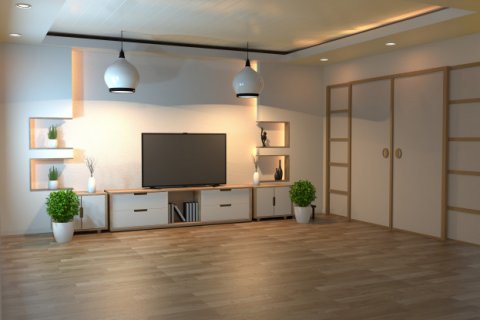
A duplex, or two-level apartment, can be found in almost every new development in Turkey — the format came into fashion some years ago and has stayed. Buyers still run into the word in listings and ask the same question: what exactly is a duplex, and is it the right thing to buy?
Below is what the format actually gives you, what it costs in 2026, and the drawbacks that tend to surface only after the purchase.
Content:
- What makes a duplex different from an apartment
- The advantages
- The drawbacks people discover later
- Two kinds of duplex: garden and roof
- Duplexes on the Turkish market
- What a duplex costs in 2026
- Who the format suits and who it does not
- What to check before the deal
- Popular questions
What makes a duplex different from an apartment
A duplex is a two-level apartment: two floors of one unit joined by an internal staircase. It sits in an ordinary residential complex alongside single-level apartments.
One thing to be clear about: in documents a duplex is simply an apartment. The TAPU records it as mesken, that is housing, and the Turkish land registry has no separate category for two-level units. The word “duplex” lives in listings, not in the law.
The advantages
- The living space divides cleanly into public and private. The lower level usually holds the living room, kitchen, study and storage, while the bedrooms and bathrooms sit upstairs, out of sight of visitors;
- duplexes are usually larger, which matters for a big family;
- the two levels can be finished in different styles, since each reads almost as a separate home;
- two generations of one family can live on separate floors, which works particularly well where the unit has two entrances, one to each level;
- upper duplexes nearly always come with a large roof terrace and lower ones with a private garden and their own way out to the grounds. A mid-floor apartment offers neither.
The drawbacks people discover later
The question in the title deserves the other side of the ledger, and some of these only become apparent once you live in the place.
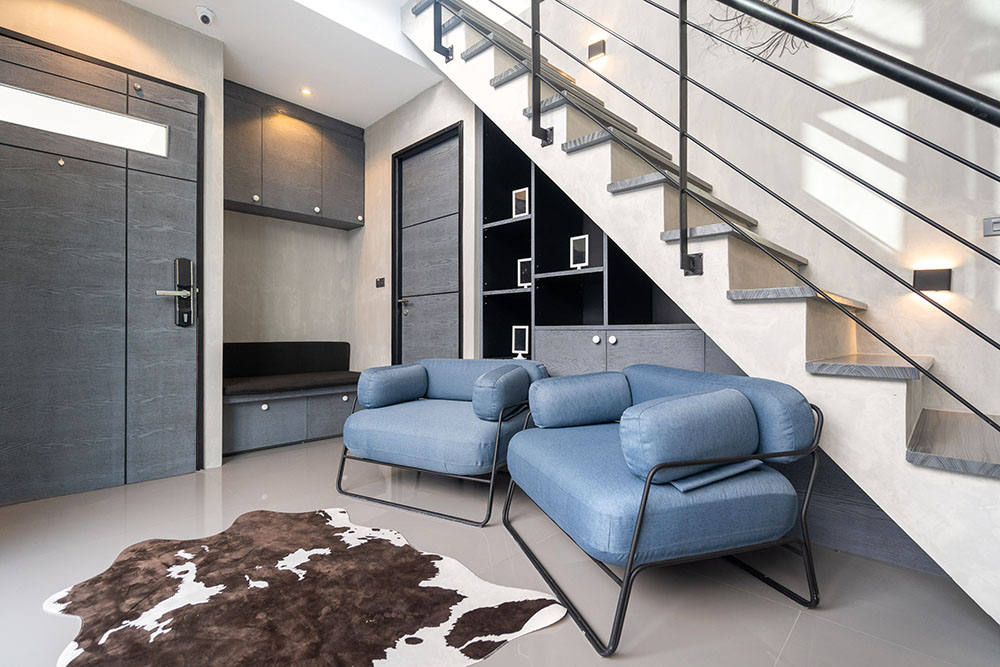
- The staircase. It eats usable space on both levels, and with age, small children or heavy shopping it becomes a daily nuisance;
- you pay for the stairs and landings as living space, and no furniture goes there;
- utility bills run higher: two levels are harder to heat in winter and to cool in summer, and each floor needs its own air conditioning;
- an upper duplex heats up badly under the roof — on the coast that is felt from June to September, and the electricity bill shows it;
- the aidat is charged by floor area, so a large duplex pays more than the 2+1 next door for the same services;
- the roof and the terrace are the upper owner’s responsibility, and that is where leaks appear after the winter rains;
- there are fewer buyers and tenants for a large two-level apartment than for a 1+1 or 2+1, so it usually takes longer both to sell and to let.
Two kinds of duplex: garden and roof
The Turkish market distinguishes two subtypes, and the difference matters more than a listing suggests.
| Type | Where it sits | What it offers | What to weigh |
|---|---|---|---|
| Bahçe dubleks | The lower level of the building | A private garden and its own exit to the grounds | Less light and view, more damp |
| Çatı dubleks | The two top floors | A roof terrace, the view, quiet | Summer heat, responsibility for the roof |
Developers most often place duplexes on the upper floors, but ground-level ones exist, so a two-level apartment in Turkey can be bought either at the bottom of a building or at the top.
A word on penthouses: advertising often conflates them with upper duplexes. The difference is one of class and contents; legally it is the same housing. The full classification of Turkish formats is in our article on the types of real estate in Turkey.
1.jpg "Is it worth buying a duplex in Turkey?")
Duplexes on the Turkish market
Duplexes are in demand with holidaymakers and with foreigners who come to work in the country. It is worth being precise, though: demand for large floor areas is narrower than for compact apartments, so a duplex usually spends longer on the market. Liquidity here is neither better nor worse than for other formats — it simply works differently, with fewer buyers but also limited supply.
What a duplex costs in 2026
The easiest way to price one is from the average price per square meter in the city. In Alanya that is around 58,700 lira, in Antalya about 55,500 and in Istanbul about 65,100.
| Option | Area | Indicative price |
|---|---|---|
| A 2+1 duplex in Alanya | About 105 sq m | Around 6.2 m TL (110,000 €) |
| A 3+1 duplex in Alanya | About 200 sq m | Around 11.7 m TL (209,000 €) |
| A 3+1 duplex in Antalya | About 200 sq m | Around 11.1 m TL (198,000 €) |
| A duplex in Mersin | About 150 sq m | Around 5.3 m TL (94,000 €) |
Calculated at the average price per meter for summer 2026 and 56.2 lira per euro for September 2026. These are guidelines rather than the price of a particular unit, which depends on the distance to the sea, the age of the building, whether the iskan has been issued and the amenities of the complex. How much floor space a given budget buys city by city is set out in our article on what you can buy in Turkey for up to €60,000.
Who the format suits and who it does not
- It suits a large family, households with several generations under one roof, and anyone working from home who wants the study away from the living area;
- it suits those who want a terrace or a garden, which an ordinary apartment will not provide;
- it does not suit a purchase aimed at letting compact housing: 1+1 and 2+1 units let faster and sit empty less;
- it does not suit older buyers or anyone with limited mobility — an internal staircase is not offset by a lift in the building;
- it is a doubtful choice for someone visiting a month or two a year: the aidat on a large area is charged all year round.
What to check before the deal
- Net against gross. In a duplex the gap is particularly wide because of the stairs and landings: ask for the usable area, not the advertised one;
- the type of deed: kat mülkiyeti means the building has been accepted, kat irtifakı that the iskan has not been issued;
- the terrace and garden: whether they are included in the recorded area and registered as part of the apartment rather than common property;
- the condition of the roof and waterproofing for an upper duplex, and drainage and damp for a lower one;
- the aidat in that particular complex — it is charged by area and is noticeably higher for a duplex;
- ceiling height on the upper level, which under a pitched roof is often lower than the photographs suggest.
The full procedure, the documents and the costs on top of the price are in our article on the procedure for buying property in Turkey, and what an owner pays month to month in the piece on the cost of maintaining property in Turkey.
“People buy a duplex with their eyes, at a viewing in April. Two things need checking: how many meters the staircase takes, and how the upper floor behaves in August,” a specialist in transaction support in Turkey says.
Popular questions
What is a duplex in Turkey?
A two-level apartment in an ordinary residential complex. In the documents it is recorded as ordinary housing; the land registry has no separate duplex category.
How does a duplex differ from a penthouse?
A duplex is any two-level apartment, including a lower one with a garden. A penthouse is an upper duplex of premium class with a roof area. Legally there is no difference.
What does a duplex cost?
Roughly from 6.2 m TL (110,000 €) for 105 sq m in Alanya to 11.7 m TL (209,000 €) for 200 sq m. The exact price depends on the distance to the sea, the age of the building and the complex.
Is a duplex worth letting out?
Long term, yes, where the format is in demand locally. But compact 1+1 and 2+1 units let faster and stand empty less.
Is a duplex more expensive to run?
Yes. The aidat is charged by area, and two levels are harder to heat and cool, so the utility bills are higher than for an ordinary apartment.