




In the East the Turkish bath is a source of youth and unearthly pleasure. It is a ritual that combines personal hygiene, rest, a way to restore your strength and a way to put your thoughts in order.
Content:
- How it works
- The Turkish hammam vs the Russian banya
- The hammam: history and today
- A visit step by step
- What a hammam costs in 2026
- Rules and etiquette
- Who should avoid the hammam
- A hammam in a residential complex
- Popular questions
How it works
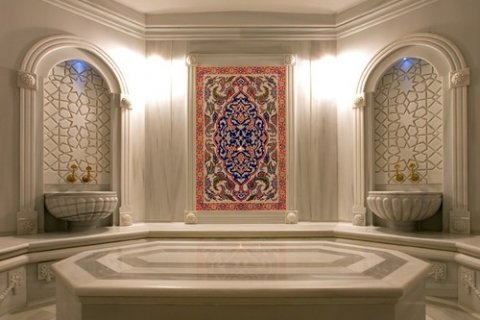
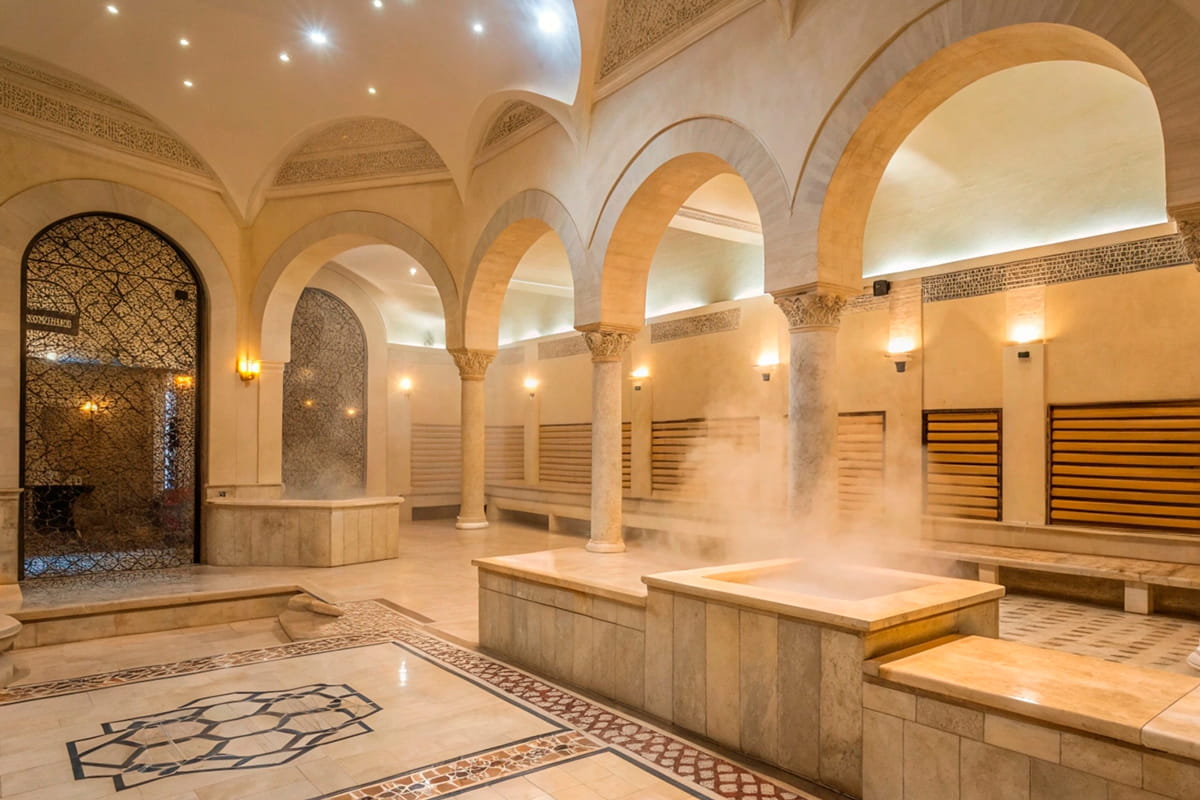
The Turkish bath is built on the principle of five fingers, or five bathing niches. Each niche has its own temperature, but the heat here is gentle: the air is warmed to 40–50 °C at a humidity close to 100%. The hottest point is in the middle, where the marble is heated to the maximum and where the sweating takes place.
The central part of the hammam is called the göbek taşı, a large heated marble platform. People lie on it to warm up and go through the main treatments, while along the walls stand kurna, stone basins with running water for rinsing.
The Turkish hammam vs the Russian banya
- Temperature
In a Russian banya the temperature reaches 110 °C, whereas in a Turkish bath it is only 40–50 °C. That makes the hammam suitable even for people who cannot tolerate high heat;
- Wetter steam
Humidity in the hammam is so high that you can see the steam. Thanks to the low temperature it is easy to bear, while in a sauna it would be unbearable and suffocating.
- A treat for body and soul
The hammam is not a place where you simply sit in the heat. It doubles as a beauty salon offering a range of treatments: wraps, massages and scrubs of every kind.
- Interior finishes
Wood, the main material of the Russian banya, is not used inside a hammam at all. Ceramic tiles are used where the budget is tight, but more often the hammam is finished in solid natural marble. It is heated by steam generators, so it is comfortable to lie on and convenient for applying masks, scrubs and other achievements of modern cosmetology.
It is worth noting that the interior of a Turkish bath is meant to be lavish, so it is not the place to economize. Going to the bath is said to have been declared obligatory by the Prophet Muhammad himself, who said: "Cleanliness is half of faith."
The hammam: history and today
The Turkish hammam owes its existence to the thermae, the ancient baths that became centers of public life in Rome. The name comes from the Arabic "ham", meaning hot. The marble benches, walls and floor of a hammam were heated by air carried from a boiler through pipes. Three pools were used for washing, with warm, cool and cold water, and people bathed in that order, starting with the warm and finishing with the icy.
There is a hammam in every Turkish village. City baths work both as architectural monuments and as ordinary neighborhood establishments for local residents. The most famous and remarkable one is the Cağaloğlu Hamamı, built in 1741 and considered the last great bath of the Ottoman era. As its owners claim, Kaiser Wilhelm and King Edward of England washed here.
In Bursa the Eski Kaplıca, the Old Baths, survive to this day; they were built by order of Emperor Justinian. Constructed on a truly royal scale, these are among the most beautiful and lavish baths in the country.
Istanbul, the main commercial, industrial and cultural center of Turkey, has dozens of historic hammams, several of them built by Mimar Sinan, the best-known Ottoman engineer and architect. His work includes Çemberlitaş of 1584, the bath most first-timers choose.
Hammams have been built in other Turkish cities too. You could, for instance, rent an inexpensive apartment in Alanya and experience the bliss of body and soul that a visit to the hammam promises.
A visit step by step
The procedure is the same in a historic bath and in a hotel spa; only the setting differs.
Step 1. The changing room. In the camekan you are given a peştemal, a thin cotton wrap, and wooden sandals. A swimsuit is allowed, and undressing completely is not the custom.
Step 2. Warming up. You lie on the warm marble of the göbek taşı for 15 to 20 minutes so the body heats through and the pores open. This is not the stage to rush: without it the scrub will be painful.
Step 3. The kese. The attendant — a tellak for men, a natır for women — scrubs the body with a coarse mitt. Grey rolls of dead skin come off, and this is the most visible part of the ritual.
Step 4. The foam massage. Soap foam is whipped up in a cloth bag, spread over the whole body and worked into the muscles.
Step 5. Rinsing and rest. Water is poured with a bowl from the kurna, after which you drink tea or sherbet in a cool room. The whole visit takes from 45 minutes to an hour and a half.
What a hammam costs in 2026
The range is wide: tourist baths in central Istanbul cost as much as dinner at a restaurant, while neighborhood ones are several times cheaper. Dollar amounts use the rate of 48.33 TL, September 2026.
| Option | Price | What is included |
|---|---|---|
| Self-service at a historic bath | from 1,200 TL ($25) | Entry, peştemal and soap; you wash yourself |
| Classic package | about 3,800 TL ($79) | Warming up, the kese scrub and a foam massage |
| Extended package | up to 7,350 TL ($152) | Adds an oil massage, facial care and a private room |
| Neighborhood bath for locals | markedly cheaper than tourist baths | The same treatments without the historic interior |
The prices come from the 2026 rate cards of Istanbul’s historic baths. In Antalya and at the resorts the treatment is usually cheaper, and hotel spas often include it in the stay.
Rules and etiquette
- The men’s and women’s sections are separate. Where there is only one hall, men and women are given different hours or days.
- The peştemal stays on. Undressing completely is not done even in a single-sex hall.
- Bring a change of underwear and slippers; everything else is provided on site.
- Tipping the attendant is normal practice and is done after the treatment.
- Photography inside the halls is not allowed without permission, and the rule is enforced strictly.
- Do not eat heavily before a visit, and alcohol before or straight after the treatment is out of the question.
Who should avoid the hammam
The gentle temperature makes the hammam more accessible than a sauna, but it still has contraindications.
People with cardiovascular conditions or unstable blood pressure: hot, humid air puts a strain on the heart.
Pregnant women without medical advice, particularly in the first and third trimesters.
Anyone with a fever, inflammation or a flare-up of a skin condition.
Anyone who has just eaten heavily or had alcohol — instead of relaxation the result is easily dizziness.
For children the visit is shortened: the coarse scrub is usually skipped and time on the hot marble is limited to a few minutes.
"Tourists often go to a hammam on the last day of the holiday, which is a mistake: after the kese the skin is especially sensitive to the sun. Plan the bath for a day when you are not going to sunbathe," says a relocation expert.
A hammam in a residential complex
For those living in Turkey permanently, a public bath is not the only option. In new residential complexes the hammam is part of the facilities alongside the pool, the sauna and the gym, and using it is already covered by the monthly maintenance fee, the aidat.
That is exactly why the fee is higher in complexes with a pool and a spa: 3,000 to 5,000 TL a month against roughly 1,500 TL in an ordinary building without facilities. What else such complexes include and how it affects the price of an apartment is covered in the article "How much does a 2+1 apartment cost in Turkey".
Popular questions
What is the temperature in a hammam?
40 to 50 °C at a humidity close to 100%. That is far gentler than a sauna or a Russian banya, where the air reaches 90 to 110 °C.
How long does the treatment take?
From 45 minutes to an hour and a half depending on the package: warming up, the mitt scrub, the foam massage and rest with tea.
Do you have to undress completely?
No. You are given a peştemal to wear throughout, and a swimsuit is also fine.
How much does a hammam in Istanbul cost?
From 1,200 TL ($25) for self-service at a historic bath to 7,350 TL ($152) for an extended package with a massage.
Can you take children to a hammam?
Yes, but time on the hot marble is limited and the coarse scrub is usually not done for children.