




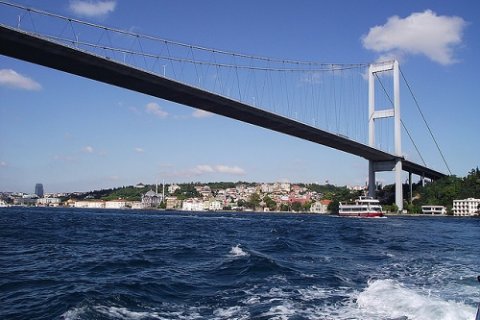
Seeing everything worth seeing in Turkey takes more than one holiday, but a trip along the Bosphorus is the exception that fits into any visit. Tradition has it that a wish made while sailing under the Bosphorus Bridge comes true. The bridge is the emblem of Istanbul and, for many, of the country itself.
Content:
- Why the bridge is said to grant wishes
- What the bridge is called today
- The one day it becomes a footbridge
- The second bridge
- The Yavuz Sultan Selim Bridge
- The three bridges compared
- What to know before driving across
- Popular questions
Why the bridge is said to grant wishes
There is more superstition than substance in it, and the symbolism comes from the place. The bridge stands where east meets west, Europe meets Asia and the two halves of Istanbul meet each other. That is why it counts as the emblem of the city, and why it appeared on the thousand-lira note between 1978 and 1986.
It opened on 30 October 1973, for the fiftieth anniversary of the Republic. At the time it was the longest suspension bridge outside the United States: a main span of 1,074 metres and a total length of around 1,560. At night it is at its most photogenic, lit in patterns that shift through the colours.
What the bridge is called today
This is what older guidebooks miss, and it causes real confusion.
The decision to rename it was taken on 25 July 2016 and took effect on 26 July: the official name is now the 15 July Martyrs Bridge, 15 Temmuz Şehitler Köprüsü. It commemorates those who died on the bridge during the attempted coup of 15 July 2016, when some of the decisive events of that night took place here.
In everyday speech, in guidebooks and in conversation it is still the Bosphorus Bridge, and that is not considered wrong. But road signs, navigation apps and official documents carry the new name, so it is worth knowing — otherwise the right exit can be hard to find.
The one day it becomes a footbridge
The views from the bridge are remarkable, but they can only be taken in on foot one day a year, during the Istanbul Marathon, which is held in the autumn with the date announced in advance. Thousands gather to run across from Asia to Europe, and those who do not run picnic on the bridge itself.
Stranger things have happened here: the racing driver David Coulthard made a demonstration run, Venus Williams played a match against the Turkish number one İpek Şenoğlu, and Tiger Woods hit balls from the deck.
The marathon is the only lawful way to be on the bridge on foot. On every other day pedestrian access is prohibited, and the rule is strictly enforced.
The second bridge
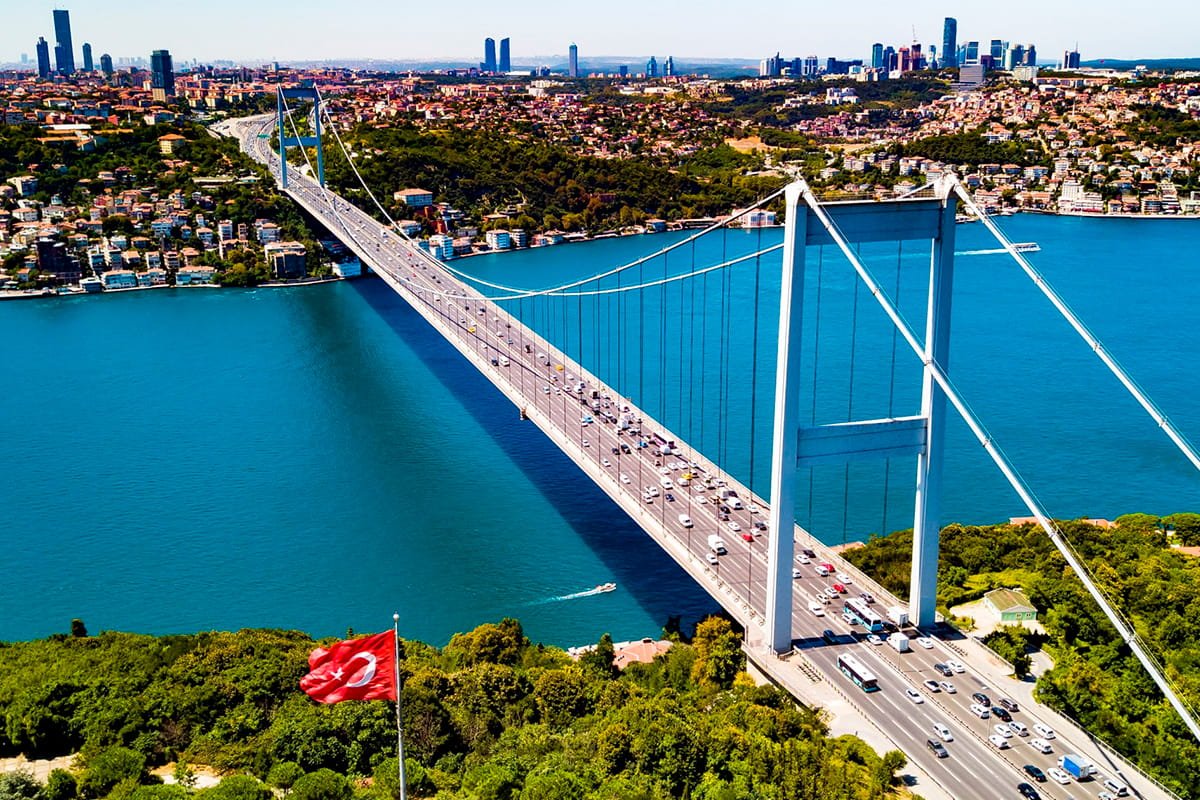
Five kilometres up the strait stands a near-twin that attracts far less attention: the Fatih Sultan Mehmet Bridge, opened in 1988 and named after Mehmed II the Conqueror, who took Constantinople in 1453. It sits beside the Rumeli Hisarı fortress and carries the transit traffic of the ring road. The differences from the first bridge come down to the direction in which the toll is charged and the arrangement of the cables.
The Yavuz Sultan Selim Bridge
Construction of the third bridge across the Bosphorus finished in March 2016 and it opened to traffic on 26 August that year. It is named after the Ottoman sultan Selim I, who reigned from 1512 to 1520.
It carries eight lanes of road traffic, four in each direction, along with two railway tracks. It is the widest suspension bridge in the world, and its towers, at 322 metres, are a record of their own. It stands at the northern end of the strait, almost at the mouth of the Black Sea, and exists mainly for transit: freight is routed over it to keep it out of the city.
One more Turkish record stands not on the Bosphorus but on the Dardanelles: the Çanakkale 1915 Bridge, opened on 18 March 2022, is the longest suspension bridge in the world, with a central span of 2,023 metres — a number chosen for the centenary of the Republic.
The three bridges compared
| Bridge | Opened | Official name | What sets it apart |
|---|---|---|---|
| First | 30 October 1973 | 15 Temmuz Şehitler Köprüsü | The city’s emblem, 1,074 m span, on foot only during the marathon |
| Second | 1988 | Fatih Sultan Mehmet Köprüsü | The ring road, beside the Rumeli Hisarı fortress |
| Third | 26 August 2016 | Yavuz Sultan Selim Köprüsü | The widest suspension bridge in the world, 322 m towers, carries rail |
What to know before driving across
- The toll is charged electronically only: there are no booths or barriers, a camera reads the plate and payment runs through the HGS system;
- a foreign-plated car must hold an HGS account, which can be opened at the border or at a PTT office;
- walking or cycling across is prohibited, the marathon aside;
- stopping on the bridge to take a photograph is not allowed and is monitored by camera;
- at rush hour the first and second bridges jam badly — locals take a ferry or the tunnel instead.
How HGS works, how long you have to pay a toll and what happens if you leave the country owing one is set out in our article on driving to Turkey.
The best way to see the bridges is not to drive over them but to pass underneath: scheduled ferries and sightseeing boats run along the strait all day and cost very little. That is also where the wish is traditionally made.
“Visitors ask how to get onto the Bosphorus Bridge on foot. You cannot, except on marathon day. From a scheduled ferry you see the same thing, without the traffic,” an Istanbul guide says.
Popular questions
What is the Bosphorus Bridge called now?
Officially the 15 July Martyrs Bridge, 15 Temmuz Şehitler Köprüsü, renamed on 26 July 2016. In everyday use it is still the Bosphorus Bridge.
How many bridges cross the Bosphorus?
Three road bridges, from 1973, 1988 and 2016, plus the Marmaray rail tunnel and a road tunnel under the strait.
Can you walk across the bridge?
Only on one day a year, during the Istanbul Marathon. At all other times pedestrian access is prohibited.
Is there a toll?
Yes, and it is entirely electronic through the HGS system. An HGS account is compulsory for foreign-plated vehicles.
Which Turkish bridge is the largest?
Of the Bosphorus three, the Yavuz Sultan Selim is the widest suspension bridge in the world. The longest suspension bridge anywhere is on the Dardanelles: Çanakkale 1915, with a 2,023-metre span.