




You can find many articles saying that Turkey is one of the most popular destinations in the world for visits and relocation, that the country is among the global top ten, and listing all the reasons why it is so attractive.
But who exactly are these migrants, how many of them are there, and which nationalities dominate the lists?
This article sets out to answer those questions and to outline the national composition of the foreigners moving to Turkey.
Content:
- How many foreigners are in Turkey now
- Foreigners in Turkey: how many there are and how they affect the country
- Why visiting, moving to and taking citizenship of Turkey are attractive
- Popular questions
- Conclusion
How many foreigners are in Turkey now
Before going through the history, here are the current figures: the picture has changed a great deal since the first version of this article.
| Indicator | Value |
|---|---|
| Foreigners holding a residence permit | 1,237,343 people (May 2026) |
| Syrians under temporary protection | About 2.3 million, down from 3.6 million in 2020 |
| Tourists in 2025 | About 64 million, fourth place in the world |
| Housing sales to foreigners | 9,354 transactions in the first half of 2025 |
| Share of foreigners in all housing sales | About 1.4% |
| Citizenship by investment since 2018 | 174,567 people |
| Investment attracted by the programme | 16.07 billion $ |
Two shifts stand out: the number of Syrians under temporary protection is falling, and the flow of foreign housing buyers has dropped noticeably from the peak of 2021 and 2022 — while Russian citizens hold first place among those buyers year after year.
Foreigners in Turkey: how many there are and how they affect the country
In 2021, gradually recovering from the problems caused by the COVID-19 pandemic, Turkey received about 5.8 million people in the first six months. That was an increase of 27.07% on 2020, when 4.5 million foreigners visited the country.
Istanbul and Antalya were the point of arrival for most visitors, being the largest cities in the country and among its main tourist destinations.
47.49% of arrivals settled in Istanbul, which is about 2.8 million people. Antalya follows with 1.5 million, and Edirne closes the top three with 611,306.
It is worth noting that despite all the problems of recent years, the 2010s and the early 2020s are still the most visited years in the history of Turkey.
So, if in the 2000s the increase in migrants was only 3.62%, then in the 5 years since 2010 their increase was 116.89% and this trend continues.
In 2018, 3% of the population were foreigners. That equates to 2.3 million people (52% of which were women). By May 2026, 1,237,343 foreigners hold a Turkish residence permit — those living in the country legally and long term, not counting Syrians under temporary protection and not counting tourists.
Let’s analyze the national composition.
National composition: who makes up the majority of visitors
Returning to the growth in the number of migrants in the first six months of 2021, 13.9% (772,437 people) were citizens of Ukraine, 13.04% (746,724 people) were citizens of Russia, and 9.02% (more than 510,000 people) were citizens of Germany.
If we go back to 2018, we will also see a large influx of migrants from Syria, Iraq, and Afghanistan. The geographical and geopolitical position of Turkey makes the country a major center for the influx of refugees from the Middle East. Syrians, Iraqis, and Afghans are the dominant nationalities in this segment of migrants.
35,000 people came from Afghanistan, 16,000 from Iraq, and 3,600 from Iran. These are the so-called “temporary migrants” who have found refuge in Turkey.
Since then, the number of Afghan citizens has declined by more than 20,000, but Syrians numbered 3.6 million by 2020. That figure has since fallen: by 2026 about 2.3 million Syrians remain under temporary protection in Turkey. The country still hosts more refugees than almost any other in the world. On the one hand, this situation transforms the sector and on the other, large remittances and loans from the European Union are a separate item of the country’s income.
A sharp increase in the number of visitors from Turkmenistan amounted to 15,000 people. These are not refugees but visitors, tourists, and possible expats.
Visitors from Uzbekistan play an important role, and for them the Turkish government has extended the visa terms from 30 to 90 and even 180 days.
A large proportion of visitors are also residents of the Western Balkans (Serbs, citizens of Bosnia and Herzegovina).
In the history of Turkey, 2018-19 saw the largest influx of foreigners, not only tourists and refugees but also expats, students, workers, and those looking for medical care.
The number of permanent foreign residents in Istanbul alone was 1,531,180. 50% of requests for residence permits came from Istanbul, the largest city in the country, although the capital of Turkey is Ankara, the other 50% from the remaining 80 provinces of Turkey.
As of 2021, 50.8% of residents were men, and 49.2% were women.
There has been an increase in the number of people who come to work and engage in scientific research and projects. A foreigner needs a work permit, which the employer requests, and the terms and quotas are set out in our article on labor legislation in Turkey.
In general, the number of visitors from Austria, Denmark, Canada, Switzerland, and Britain has increased in the country. The number of Americans, Swedes, Norwegians, Italians, Belgians, and French has decreased, but not by much.
One qualification about Turks themselves: there is no official statistic on the ethnic composition of the country’s citizens. The census does not ask about ethnicity, and the religion field has not been printed on the identity card since 2017. Every figure about the “national composition of Turkey” is an estimate. More on this in our article on the 10 features of Turkey.
Tourists in Turkey
Turkey received over 10.88 million tourists in the first seven months of 2021. That was an increase of 85.44% on 2020. 38.2% arrived in Istanbul.
15.41% were citizens of Russia, 12.5% of Germany, 11.08% of Ukraine, 4.85% of Bulgaria, and 4.3% of Iran.
In comparison, 12.7 million people arrived in Turkey in 2020. In 2025 the country received about 64 million visitors and took fourth place in the world by tourist numbers. The market has not merely recovered from the pandemic slump — it is five times larger than in 2020. It is worth noting the many visitors from the Netherlands, Belgium, and Slovakia.
Developers also indicate that they sell 90% of real estate to foreigners. That figure should be read as a claim by individual developers about their own projects: according to state statistics foreigners buy about 1.4% of all housing sold in the country. Ninety percent is possible in a particular resort complex built for foreign buyers, but not across the market.
Investors and direct investments in the country’s economy
Let’s consider the number of investors who have arrived in the country and the volume of direct investments in the economy.
It is difficult to find data on the exact number of investors entering the country, but we can identify these foreigners by indirect data on the amount invested.
Start with the current state of the housing market. In the first half of 2025, 691,893 homes were sold in Turkey, of which 9,354 went to foreigners, about 1.4% of transactions. Russian citizens lead with 1,655 purchases. The peak was in 2022 and 2023, after which foreign demand declined, driven both by rising prices in dollar terms and by the higher thresholds for residence permits and citizenship.
By the end of the year, Turkey expects a total investment of $7.5 billion in its real estate. Then the country will consolidate its position in the top 10 real estate markets worldwide. That was a forecast made for 2021.
A member of the board of directors at the Real Estate International Promotion Association, Hakan Bucak, points out that citizens from 80 countries are interested in the country’s real estate, especially wealthy buyers from Russia, Iran, and Iraq. Investors from America, Canada, and Britain also pay special attention to the market.
Last year, Turkey received 6 billion for the sale of more than 40,000 properties.
Buyers from Western countries are more active, accounting for 30,849 residential properties sold in the first 8 months of that year, an increase of 47.6% on the year before.
The average price of a property purchased was $150,000. For comparison with today: the average apartment in the country costs about 5.2 million lira, roughly 108,000 $. What a given budget buys and how many square meters it covers in each city is set out in our article on what you can buy in Turkey for up to €60,000.
From January to August 2021, the number of properties purchased by foreigners grew by 47.6% compared to the same period in 2020. In August alone, 5,886 properties were sold, a rise of 50.7% on August 2020.
Data from the Astons research agency indicate that 13,325 people applied for a resident visa for investments.
Unfortunately, it is difficult to find information on the exact number of investors in the country, but according to the available data we can talk about several tens of thousands. That estimate has since been confirmed officially: according to the Minister of the Interior, 51,762 investors have obtained citizenship by investment since 2018.
The aggregate investment data for the last 17 years can tell us more about the national composition. The Investment Bureau under the President of Turkey indicates that the main countries where foreign nationals invest in Turkey are the following:
- Netherlands — 15.9%;
- USA — 7.8%;
- United Kingdom — 7.0%;
- Gulf countries — 7.0%;
- Austria — 6.4%;
- Germany — 6.2%;
- Luxembourg — 6.0%;
- Spain — 5.8%;
- Belgium — 5.3%;
- France — 4.6%;
- Azerbaijan — 4.3%;
- Greece — 4.1%;
- Other — 19.5%.
Russia is a relatively new country among those whose citizens invest in Turkey, so it falls under “other”. That has changed since: by number of housing purchases Russians have moved into first place among foreigners and have held it for several years. In the statistics of foreign direct investment, which count corporate money rather than apartment purchases, the ranking is still different.
Foreigners who became citizens
It remains to look at how many foreigners have become citizens of Turkey. The citizenship by investment programme was launched in 2017-18 and by now there are concrete results.
According to official figures announced in May 2026, 174,567 people have obtained citizenship by investment since 2018: 51,762 investors and 122,805 members of their families. The programme has brought 16.07 billion $ into the country’s economy.
The growth was exponential, since in the whole first year of the programme only 70 people obtained citizenship by investment.
That growth was linked to the reduction of the minimum investment from $1,000,000 to $250,000 in 2018. Since June 2022, however, the threshold has been raised again, to 400,000 $, and that is the figure in force now. In addition the property cannot be resold for three years, and the valuation is carried out by a licensed expert. From September 2018 to December 2020, 7,242 people from 93 countries became citizens.
The leading countries are Iran, Afghanistan, Iraq, the USA, Canada, the United Kingdom, and Russia.
How a residence permit differs from citizenship and which of the two suits a particular goal is covered in our separate article on residency or citizenship of Turkey.
Why visiting, moving to and taking citizenship of Turkey are attractive
Let’s briefly go through why all these people are drawn to Turkey.
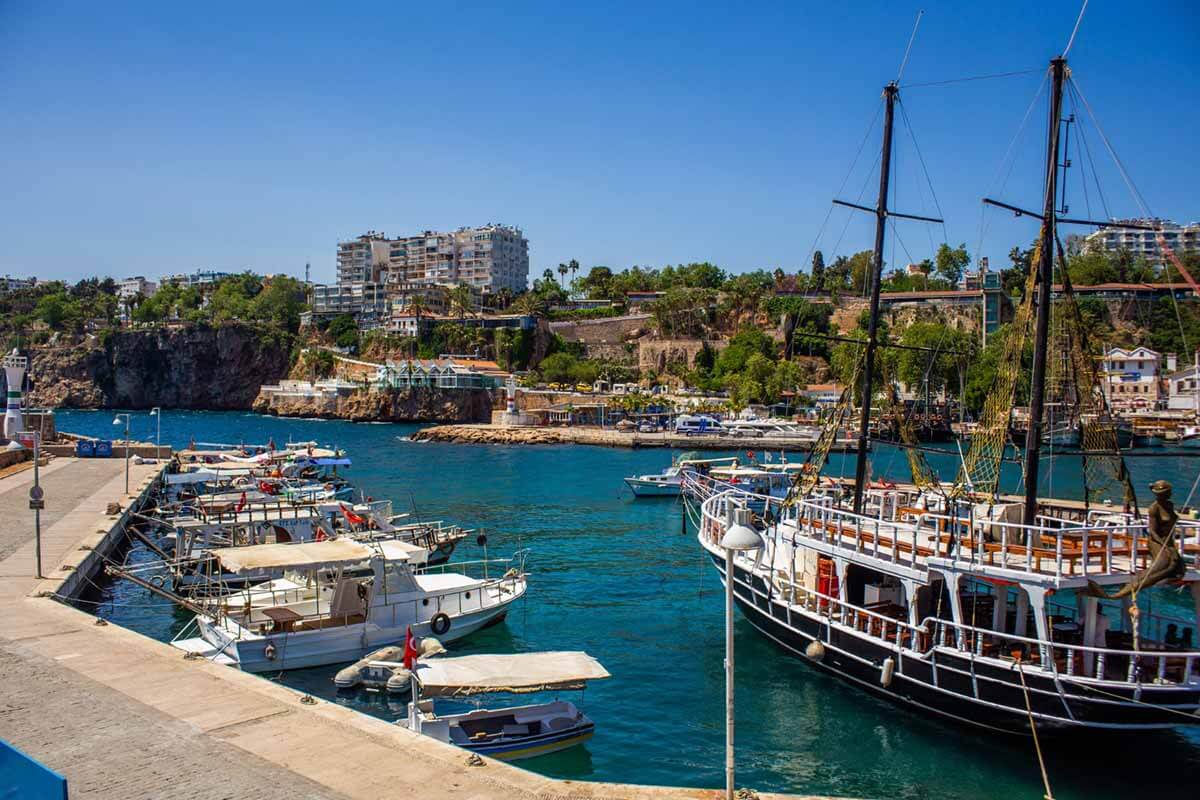
Tourism is the simplest case. Turkey is a large country on the boundary between Europe and Asia, with varied terrain, climates, resorts and destinations of every kind.
For culture and sightseeing, visitors go to Istanbul. Antalya, another large city, combines the same with a wide choice of beaches for a summer holiday.
Along the coast to the west from Antalya to Kusadasi, there are a variety of resorts, large and small.
In the Asian part of the country, Anatolia, there are many mountain resorts.
The country has low prices for resort holidays and favorable rental rates for hotels and apartments, and it is equidistant from the CIS region, Europe and the Middle East.
Turkey is attractive to investors because it has a young economy. Many of its sectors, including real estate, are actively developing. One qualification is needed for the picture to be complete: prices in lira rise quickly, but so does inflation, so in dollar terms the growth is far more modest and in some periods turns into a decline.
The situation is also helped by a young working-age population.
Housing is affordable, though not as affordable as a few years ago: an average apartment in the country costs about 108,000 $, and in Istanbul and the Aegean resorts considerably more. The maintenance of such real estate is also low.
The country’s infrastructure and its IT sector are developing.
The interest on loans is not the lowest, but borrowers are compensated by a range of benefits and special programmes provided by banks.
How to obtain Turkish citizenship
It is easy to obtain citizenship or long-term residence in the country, with minimum requirements for the conditions and the documentation. Any investor can become a citizen without even visiting, by doing everything remotely or through a trusted person or company. One clarification is due here: since 2024 biometric data has to be submitted in person when applying for citizenship, so the procedure is no longer fully remote.
Having obtained citizenship in Turkey, you can enjoy visa-free travel to around 110 destinations, of which some 97 are fully visa-free while the rest issue a visa on arrival or an electronic authorization, as well as a special E-2 investor visa for the United States.
Listing the advantages would take time, but it can be summarized in two points:
- Turkey is a young country with a young and actively growing economy, a favorable geographical location, and growth potential.
- The Turkish government understands this and makes every effort to create an attractive investment climate with favorable loans, simplified procedures for opening or transferring a business, migration of capital and labor, and simple procedures for obtaining the necessary documents, permits, and licenses, including citizenship.
“Foreigners in Turkey tend to be counted as one mass, when in fact they are three separate groups with separate rules: refugees under temporary protection, residents holding an ikamet, and investors. There is almost no overlap between them, and their statistics cannot be added together,” a migration consultant says.
Popular questions
How many foreigners live in Turkey?
As of May 2026, 1,237,343 people hold a residence permit. Counted separately are about 2.3 million Syrians under temporary protection.
Who buys the most housing in Turkey?
Russian citizens: in the first half of 2025 they completed 1,655 of the 9,354 purchases made by foreigners.
How many people have obtained citizenship by investment?
174,567 since 2018, of whom 51,762 are investors and 122,805 family members. The programme has brought 16.07 billion $ into the country.
What is the current threshold for citizenship?
400,000 $ for a property purchase, in force since June 2022. The earlier 250,000 $ no longer applies.
How many tourists come to Turkey?
About 64 million in 2025, which puts the country fourth in the world.
Conclusion
Having read up to this point, you may ask why this information is useful to you.
First of all, we wanted to outline the national composition of foreigners in Turkey. Who they are, where they come from and why.
We encourage you to pay more attention to this issue by contacting specialists, such as lawyers, business consultants, or real estate agents, depending on your goals.
Knowing the national composition of visitors to Turkey has many useful consequences. Each nation has its own culture, preferences, and worldview. If you are an investor and want to make money by letting to tourists, you should know who the majority of your customers will be.
Visitors from Iran, the Gulf states, Russia, or the UK are different categories of the population, with their own preferences for the types of real estate they will rent, their location and configuration, the types of recreation and resorts that suit them, and their notions of what is expensive and what is cheap.
If you are going to make money on flipping or by opening a business, you should pay attention to Istanbul, as this city is where most of the foreigners settle who come to the country for something other than sightseeing.
If you are an expat, it may matter to you how many of your compatriots you will meet in the country, or not meet.
It is useful to study not only the residents of the country you are moving to but also the residents of the countries moving there alongside you.